 English
“What is not possible is being in the world, with the world and with others, without being touched by a certain comprehension of our own presence in the world. It means, without a certain intelligence about the history and our role in it. “
(Paulo Freire, complaint, announcement, prophecy, dream and utopia – The book of prophecy. Brazil in the third millennium)
In Morro Vermelho district, Caeté city, Minas Gerais, José Pereira Peixoto Filho, Professor Doctor Education Program of Graduation FAE / CBH / UEMG, conducted a survey that included the participation of eleven students from 35 to 70 years of Education for Youth and Adults people (EJA) and classroom teacher. The objective of the study by Carolina Rezende Souza, bacharel in Social Sciences by PUC Minas and Master in Education by SAF/HBC/UMEG, which lasted two years (2011-2013), was to understand how learners construct their materials and existential territories, associated with their different views of the world. It is important to consider that this research was funded by the Coordination for the Personnel Improvement of Higher Education (CAPES / INEP) and Centre for Rural Education, constituted by universities: UEMG, UFV and UFSJD.
Having popular education as a reference, the research aimed to identify different views of the world from the experience of students in the areas of rural community, which has 1200 inhabitants. The experience was based on creativity and authorship of the participating students. José Pereira Peixoto and Carolina Souza Rezende made pedagogical workshops inspired on Paulo Freire’s assumptions, with production and socialization of images, texts, drawings, artifacts and the ownership of objects brought by the learners themselves.
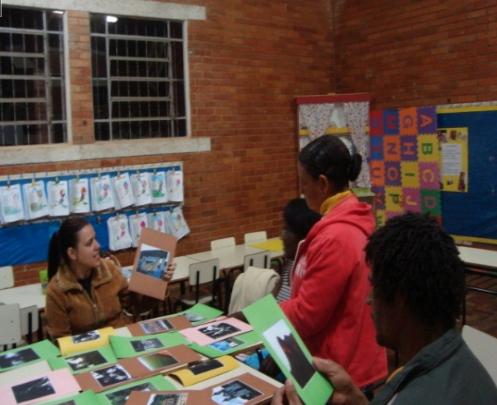
One of the pedagogical workshops made to image reading by students EJA
13 pedagogical workshops were performed (FIG. 01; FIG. 02) whose reports were able to identify the constitution of religious, school and family territories. The way the students see the territory of Caeté community was also evident. They realize it through their economic activities such as monoculture eucalyptus plantations and mining, as well as dialogues, oppositions between traditional and modern, as well as the perception of resistance on certain changes in rural areas, especially in rural family and the new powers granted to these spaces.
Therefore, the EJA learners speech revealed the limits faced in activities. However, there were also reports on the construction of knowledge with pleasure in the exercise of subjectivity, intersubjectivity, dialogue, creativity and authorship. And more than this, we can consider that the pedagogical workshops highlighted the importance of the implementation of initiatives to enable the recovery of young and adult workers as protagonists of their individual and collective trajectories.
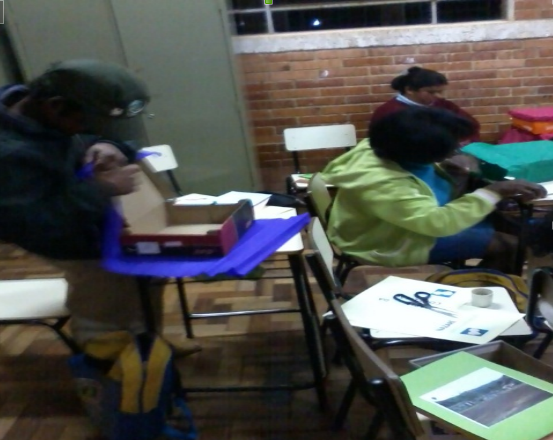
One of the pedagogical workshops made for construction of cultural artifacts to express the EJA learners’s world views