 English
“What moves me to be ethical, above it all, is to know that, being education, for its own nature, policy and political, I must, without ever to deny my dream or my utopia for students, respect them.”
(Paulo Freire, Pedagogy of Hope)
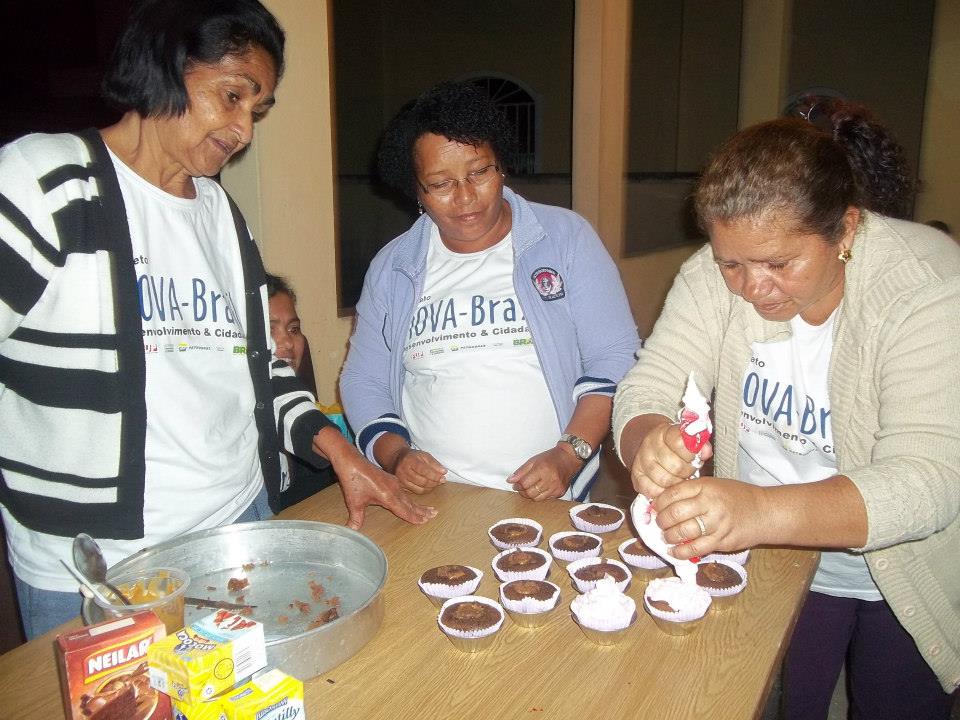
Students from Renascer-Belford Roxo Nucleus making Cupcakes
Inspired by the Youth and Adult Literacy Movement (Movimento de Alfabetização de Jovens e Adultos – MOVA), created by educator Paulo Freire, the MOVA-Brazil project is developed by Institute Paulo Freire (IPF) in partnership with Petrobras and with the Single Federation of Oil Workers (FUP). The MOVA-Brazil aims to promote human dignity through a literacy course that improve the citizen participation, employment and income generation conditions. This ensures learners and communities the opportunity to rebuild their destiny and earn the right to full and participatory citizenship.
In 2014 the MOVA-Brazil project completes 10 years of existence.
The actions developed in this period produced good results not only in relation to learning of reading and writing, but also in relation to the politicization of students. The methodology created strengthened the exercise of citizenship and included actions aimed at generating jobs and income, in order to improve the quality of life of those involved.
In Rio de Janeiro polo, for example, groups of 21 municipalities in the state produced crafts from newspaper, sewed pieces with fuxico, made tapestries, jewelry, embroidery, crochet, produced breads, cakes and pastries, manufactured handmade soap, developed cooking from the reuse of food, among other activities. Sharing experiences and learning caused the spread of knowledge and resulted in the formation of groups of learners who started to meet with the objective of improving their products, increasing the possibility of their commercialization and effective income generation. There was an increase in the quantity and quality of handmade products sold by the learners themselves in their communities.
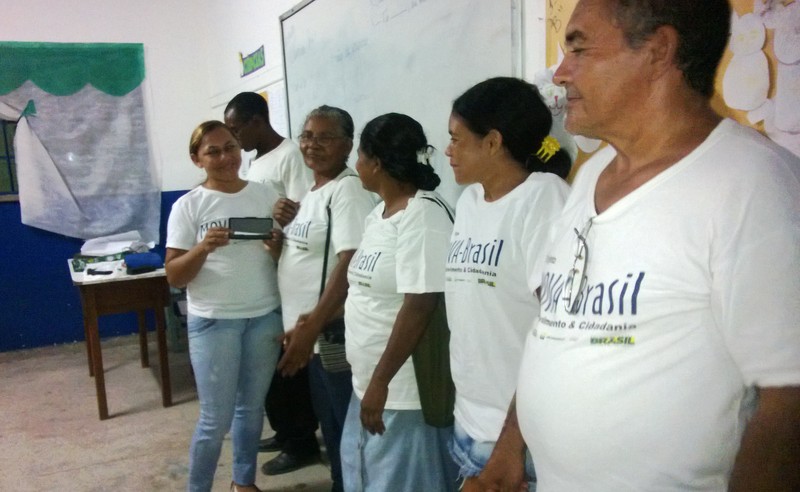
Students presented with glasses.
In the state of Amazonas Polo, in northern Brazil, the Caramuri nucleus, from Rio Preto da Eva municipatlity, promoted a social action performing eye exams on students. Vision problems were identified as a major cause of the difficulties of the participants to continue the studies. Through the problem posing methods, the students claimed a position of public authority. The result was a great joint effort of exams, conducted in partnership with the Department of Social Services and the Department of Community Support.
“MOVA-Brazil” has promoted a literacy that goes beyond decoding the letters, contributing to the inclusion of learners in the world of jobs and the construction of a critical vision to change their own lives and the world where they live.