 Portuguese
 With the sponsor of Petrobras, a semi-public Brazilian multinational energy corporation, through the Federal Law of Culture Incentive, from the Ministry of Culture, the Paulo Freire Institute of Brazil developed between the years of 2011 and 2012 the project: “Paulo Freire Memória e Presença: preservação e democratização do acesso ao patrimônio cultural brasileiro” (in English, Paulo Freire Memory and Presence: preservation and democratization of access to Brazilian cultural heritage). The project had as general goal to preserve the existing materials, to ensure and democratize the qualify access to work and legacy of Paulo Freire, including those with visual impairment.
To manage that, it organized and cataloged the physical collection of “Centro de Referência Paulo Freire – CRPF” (in English, Reference Center Paulo Freire). CRPF is one of the four affiliate institutions to Paulo Freire Institute of Brazil and dedicates itself to preserve and divulge the memory and legacy of Paulo Freire. Of public nature and free access, there you can have contact with texts, images, audios and videos related to the educator and also some of his personal objects. The project dedicated itself, concretely, to scan thirty pages of texts, hundred videos, two hundred tapes, five hundred photos produced by Paulo Freire or that appear the educator and, in the perspective of social inclusion, to make available two thousand “of” and “about” Paulo Freire to visual impairment people; scan twenty thousand pages of text, a hundred videos and two thousand five hundred photos produced by the Paulo Freire Institute, as reinvention of his legacy; make available both in attendance and virtually the scanned collection of the “Centro de Referência Paulo Freire”.
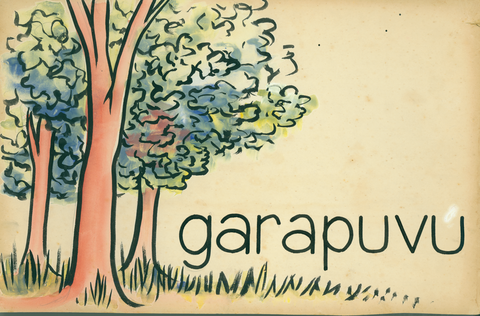
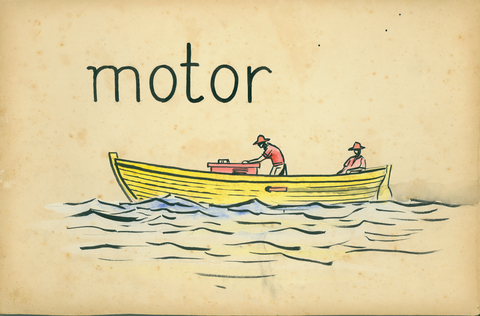
At the same time that the project started to be available in the network, the own team started a campaign, which is intended to never be closed, to gather more known information and materials relative to Paulo Freire’s legacy that could be spread throughout the world, in institutions or physical persons, that he passed by or had any contact with him. One of the ways that until today is available is the collection’s email (acervo@paulofreire.org) and was by it that came to institute, on 01 July 2011, an email of Dona Rosamaria da Silva Beck, who was Chief at the Department of Administration and Maintenance of the “Instituto Federal de Santa Catarina – IFSC” (in English, Federal Institute of Santa Catatina): “There are with me the foils, bases of slides of a literacy group following the Paulo Freire’s method, used in Florianópolis, Santa Catarina, in January 1964. The work was developed by the Students Union of Santa Catarina and by the Popular Action, during the called ‘Multirão de Cultura Popular’ (in English, Popular Culture’s Joint Effort). I have also this material scanned. Looking forward for a manifestation of the collection group”.
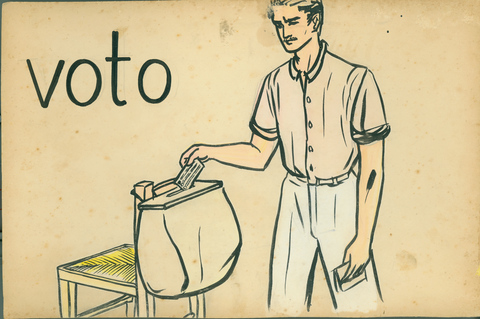
It could be, according to Beck, from the “second or third [produced material] after Angicos”. According to her, this material, which is a set of approximately 30 foils illustrated in cardboard paper, that passed a long time hidden, during the dictatorship. Brazilian Army, right after the coup of 64 (a set of events occurred between 31 March and 01 Abril 1964 which culminated with the dismissal of President João Goulart and with the implementation of a military regime that would control the country until 1985, politicaly aligned to USA), was interested in confiscating such material. It was gone the slides and stayed the original foils. Recently, when the IFSC, along with “Banco do Brasil” (in English, Bank of Brazil), organized a training on Paulo Freire’s Method and invited Professor Rosamaria to participate, she remembered of the slides, gathered some of them that were in different locals and people and showed to the course group. She even had her own space after the official period destined to the course’s content to only describe the first experience of literacy that used this material. Successive times the professor would be invited to present the material in these workshops of “Banco do Brasil”.
As the professor was in a long medical treatment, right after to turn seventy years and is newly retired, wanted to keep the material in safety, that’s why she sent it to Paulo Freire Institute, besides also fear the “(…) oblivion and the lack of knowledge of our educational history, [that] may cause its disappearance”. In the same month of january 1964, which Paulo Freire would be in Florianópolis facilitating a training, more specifically on day 21, the Decree No 53.465 instituted the “Programa Nacional de Alfabetização” (in English, National Program of Literacy), consecrating the “Sistema Paulo Freire para Alfabetização em Tempo Rápido” (in English, Paulo Freire System to Literacy in Fast Time). The “Programa Nacional de Alfabetização” foresaw the “cooperation and services” of “student and professional colleges, sportive associations, neighborhood and cities associations, religious entities, governmental, civil and military organizations, patron association, private companies, diffusion organisms, the magisterium and all mobilizable sectors”. Paulo Freire always defended the need of popular participation in the struggle against illiteracy.
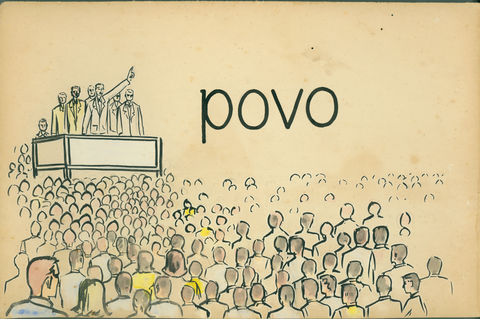 The program foresaw the creation of 60.870 Culture Circles, each one during three months, in all federal units, to literate, in 1964, 1.834.200 illiterate ranging from ages 15 to 45 years old. Its implementation accomplished by the pilot-projects in the region of South, Southeast and Northeast. Paulo Freire would travel, then, the country structuring the “Programa Nacionalde Alfabetização – PNA”, that would be initiated at “Baixada Fluminense” (in English, Fluminense Lowlands – a region of the State of Rio de Janeiro) in the begging of 1964. PNA represented a qualitative leap regarding the previous literacy campaigns.
In a metalinguistic way, this also means today, and the donation of these foils proves this, that is very possible to be found others unpublished documents “of” and “about” Paulo Freire in these poles that were initiated pilot-projects.
On 14 April, right after the coup, the Decree No. 53.886 extinguishes the “Programa Nacional de Alfabetização”. In this same date, MEC (Ministry of Education and Culture) “revoked all the previous decrees and divulged, by the press, a survey of the material used in literacy campaign, with the ‘inventory of a vast photographic equipment, valued at several million of cruzeiros and subversive publications’ that would be then exposed to visitation” (Beisiegel, 1974:171).
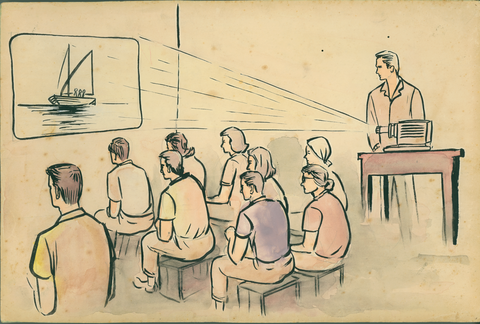
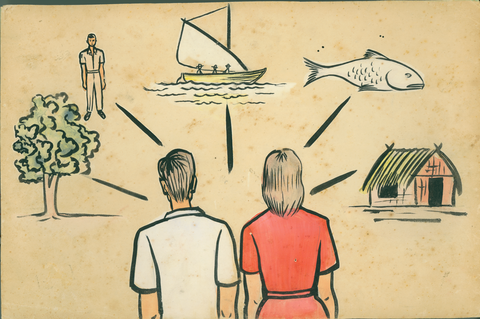
The foils from Santa Catarina State, representatives of a thought and an approach that in a period of history were extolled by a president and transformed in national strategy and and in another period hunted by another president as subversives, are of an incommensurable kindness: fishermen going to the sea with simple sailboats, fishing net, fishing knife, a woman at the loom, BRICK, VOTE, TRUCK, FUTBAL, BRAZILIAN FIRETREE as generate words. There are foils projecting the own Culture Circle, that is, in which they find themselves seeing the images of the slides. The same investigation of the vocabulary universe, that takes to syntactic plan and that is in the political plan of Angicos’ experience is possible to find, with own scale, in this newly discovered material of the Brazil’s South.
The struggle against illiteracy in Brazil, that had – particularly at that time, 50 years ago – a huge political value, to form new voters, was an important step in the citizenship reconstruction in Brazil. Today, in the other hand, is already being possible to democratize the access to the historical process built by contributions of Paulo Freire to the world.
To access other foils, visit the digital repository of the Project: http://acervo.paulofreire.org/xmlui/handle/7891/3440