 Portuguese
Instituto Paulo Freire – IPF (in English, Paulo Freire Institute) is a civil non-profit association, created officially on 01 September 1992 based on a dialogue with Paulo Freire on 12 April 1991. Nowadays, considering Paulo Freire Chairs and Institutes around the world, IPF is, in fact, a global network integrating people and organizations distributed among 90 countries in all continents, with the main goal to continue and reinvent Paulo Freire’s legacy. Freire had been present during all the IPF creation and participated in discussions regarding the primary statute, the definition of the institute action field and also took part on the main decisions and projects in the early years of the institute.
In Brazil, IPF develops assistance and consultancy projects, researches, initial graduation (presence and distance) and continued education, guided by social-environmental and inter transcultural dimensions, containing three actions areas: Adults Education, Citizen Education and Popular Education. Our actions are founded on the horizontality principle and collective work, using a methodology essentially dialogic, inclusive, based on the incentive to the self-organization and self-determination. IPF is divided, roughly, in Founders (from the International Council of Assistants), Board of directors (Pedagogy, International Development, Administration and Knowledge Management), Areas (Adults Education, Popular Education, Youth and Adults Education), sectors (Information Technology, Communication and Distant Education) and Associated Entities.
Its is about the associated institutions to Instituto Paulo Freire that we would like to dedicate ourselves in a first moment and, in this text more specifically, trace a contemporary profile of one of them. The associated institutes began to appear in the IPF Brazil in the year of 2005, when occurred updates in the administrative procedures, in its internal regiment, in its formation policy and it is in this moment that also has the statute reformulation in the institution. These entities are linked to the institutional IPF aims and driven by the four board of directors.
The Centro de Referência Paulo Freire – CRPF (in English, Reference Center Paulo Freire), that was already conceptualized on the Memory Section, is one of these associated entities. It was created as a Paulo Freire Library’s deployment, managed by IPF since 1997, after Paulo Freire’s children donated to the Institute around seven thousand volumes, between books, magazines and documents that belonged to the educator. CRPF, physically, is structured in two collections: Acervo Paulo Freire (in English, Paulo Freire Collection) – personal libraries and the productions of the author himself) and Acervo Instituto Paulo Freire (in English, Paulo Freire Institute Collection) – collection of Moacir Gadotti and the institutional productions). It is possible to know two projects of the entity very well by internet: the Memory Project (Paulo Freire – Educate to Transform, of 2005), through the website http://www.projetomemoria.art.br/PauloFreire/index.jsp, and Paulo Freire Project Memory and Presence – Preservation and democratization of access to Brazilian’s cultural heritage, through the website http://acervo.paulofreire.org/xmlui.
Casa da Cidadania Planetária – CCP (in English, House of Planetary Citizenship) is a institution maintain by the Paulo Freire Institute that has as goal develop programs, projects and participate of discussions forums and social mobilization – local, regional, national and international, having as main challenge to contribute to the construction of planetary citizenship, active and critical, in different educative spaces, in the perspective of a culture of sustainability. It acts through 03 programs: “Programa de Mobilização Social” (in English, Program of Social Mobilization) – integrating IPF to several forums of discussion and local. Regional and planetary social movements, with highlight to World Forum of Education and World Social Forum); “Programa Educação para a Cidadania Planetária” (in English, Education for a Planetary Citizenship Program) (http://rede.unifreire.org/programa-educacao-para-a-cidadania-planetaria), that assumes strategies to rethink the current model of society and propose new learning ways and new policies of participative environmental management, in the perspective of promoting values and knowledge foucused at the exercise of planetary citizenship; “Programa Município que Educa” (in English, City that Educates Program)(http://www.municipioqueeduca.org/) has as fundamental goal to maximaze and strengthen the educative dimension of several initiatives of the cities. For that, proposes a new conception of public management’s architecture that consists in promote articulated and inter-sectoral actions, narrow the relationship between State and Civil Society and propose a new logic of social management of knowledge.
The Editora e Livraria Instituto Paulo Freire – ED,L (in English, Publisher and Library Paulo Freire Institute) was created in 2008 as a filial. Its mission is to publish works of educational and pedagogical relevance with the intente to democratize information, knowledge and known, and to make more accessible to all people, in special to educators, works of mester and inspiring Paulo Freire (1921-1997). The Library acts as extension of of the Publisher Paulo Freire Institute in order to enable the distribution and socialization of publications, facilitating the quick access to interested persons. On 23 April 2013, on World Day of Book, Ed,L launched its digital store (http://edlpaulofreire.org/).
And, lastly, the last associated entity that left us to describe is Universitas Paulo Freire, well known as UniFreire.
A net of networks
Universitas Paulo Freire – UniFreire is constituted by a network of freirean people and institutions of several countries, such as Paulo Freire Chairs and Institutes, groups, centers of research or high education institutions. UniFreire organizes itself as a production space and publicity of knowledge, having as horizon the primary sense of Universitas, the multiple knowledge, and the construction of planetarization, a counter-hegemonic perspective alternative to cultural, economical and political models anchored in the neoliberal globalizing process.
Besides of corresponds a varied number of demands from freirean community, promotes, coordinates and/or assists the frame of international meetings of Paulo Freire Forum (see matter Paulo Freire Institute of Italy publishes a journal about the Forum of Los Angeles). UniFreire arose, still only as a project, in 2000, in the II International Meeting of Paulo Freire Forum, held in Italy. In that event, held between 29 March and 01 April, was approved the Letter of Bologna, symbolically its “birth certificate”. In the document are explicit the principles and general references that guided the frame of the pro Universitas Paulo Freire movement.
It constitutes itself in an articulator, transnational center, configured by the educative use of virtual and presence space, where the information and knowledge are referenced by freirean ideas and ethic and, at the same time, anchored in the scientific rigor and in the radicalism of know democratization.
UniFreire divides itself in 03 big scopes and in the latest years several reasons (among them mainly the emerging demands that daily arise in the institution and the major projects linked to notices and partnerships and with many deadlines, as happened with the Memory and Presence Project, a project of CRPF and that was coordinated by the coordinator of UniFreire, Anderson Alencar) took it to empathize two of them: articulation and formation. The proposal of this matter is to underline that has been the most important in recent months in each of this scopes, as is the horizon of view of the institution to retake in UniFreire the third and very important adjourned scope, the dimension of research.
The Scope of Formation
During the years, UniFreire was the promoter and/or testifier of a series of free courses developed by IPF, in different partnerships with others associated entities, areas and sectors of IPF, such as Earth Charter in Education; Culture, Education and Society; Teaching in Freirean Perspective, Youth and Adults Education, among others. There is a list of them available on the website of IPF Brazil, at the page of UniFreire. The highlights more recent of this dimension are going to two big actions:
Specialization Course (lato sensu) on Curriculum and Teaching Practice – it is about a partnership made between Instituto Paulo Freire/UniFreire, Faculty of Mauá and the Secretariat of Education of the city of Osasco, initiated on April 2012 and that will be ended on May 2013. 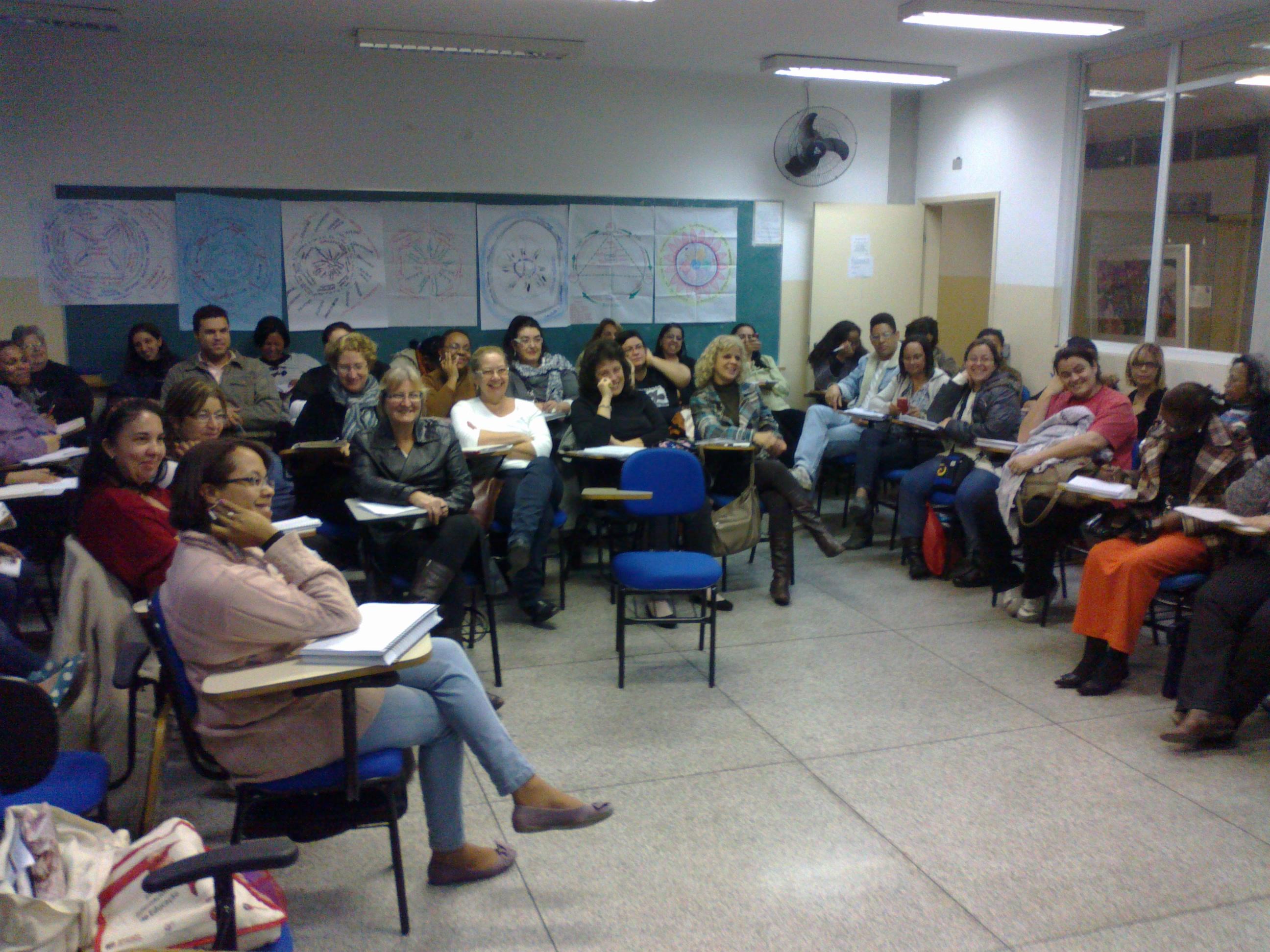 The course had duration of 480 hours: 40 of these hours were to distance activities, through a specific virtual environmental, for orientation and elaboration of the intervention project at network schools to be made by students, besides of 80 hours of credits to the production of a scientific article. From April to June of 2012, the course developed itself around the first thematic module, to know: “O significado do currículo e políticas educacionais no Brasil” (in English, The meaning of curriculum and educational policies in Brazil). From August to December of the same year, around the module II, “Fundamentos do currículo” (in English, Foundations of curriculum). As third and last module, from Februrary to May of 2013, it developed itself around the thematic “Práticas de ensino e formação humana” (in English, Practices of teaching and human formation); There are over 60 students, divided in two teams, that will have the specialist titles and also will have their monographs published in a specific periodic to this occasion (http://www.paulofreire.org/unifreire/cursos/curso-de-especializacao-curriculo-e-pratica-docente)
Internal Formation at Paulo Freire Room, IPF Brazil, April of 2013
The Internal Formation – regarding this aspect, UniFreire structured a document that is called “Política de Formação Interna” (in English, Policy of Internal Formation). From a proposal more complexly elaborated of continued/procedural institutional evaluation in 2012, the majority of collaborators of Institute contributed and was possible to identify conjunctural themes for the institution, that will have an exclusive formative space and for all, as well as identify important thematic for each area/associated entity/sector.
In the year of 2013 there was already a space to discuss, making invitations to researchers and agents publicly recognized by the relevance in this subjects, preconception and discrimination, the international day of woman struggle, cognitive aspects of youth and adults education. In this same year there are already expected internal formations with all of our staff and collaborators, in dates to be confirm yet, about the following themes: Social Movements in Brazil, in the World and in Forums – WSF_2013 – with Ladislau Dowbor; Neoliberalism, Globalization and Education; Culture in Paulo Freire; Democratization of Communication in Brazil, besides of technical workshops (free software, administrative and financial flows. As there are many agents also in IPF and all of them develop actions of formative and institutional interest (such as, CRPF when it retakes the Paulo Freire Chair and promotes cine-debates and soirees open to all), UniFreire is responsible by the systematization and accompaniment if these formative actions, before, during and after their accomplishments. In this same sense, aiming internal formation, that executes the mapping and socializes most important information on all scientific events held in Brazil and in the world, as well as all notices for development of projects of IPF interests, both from public or private fomentation.
The Scope of Articulation
Update of Freirean Community Mapping – recently, UniFreire internally structured (and, therefore, institutionally) a movement to map and systematize the main information around institutions, in Brazil and in the World, inspired by the freirean thought. It socialized through all world a form in three lines that asked basic information, new and capable of trace a satisfactory description of each one of them. 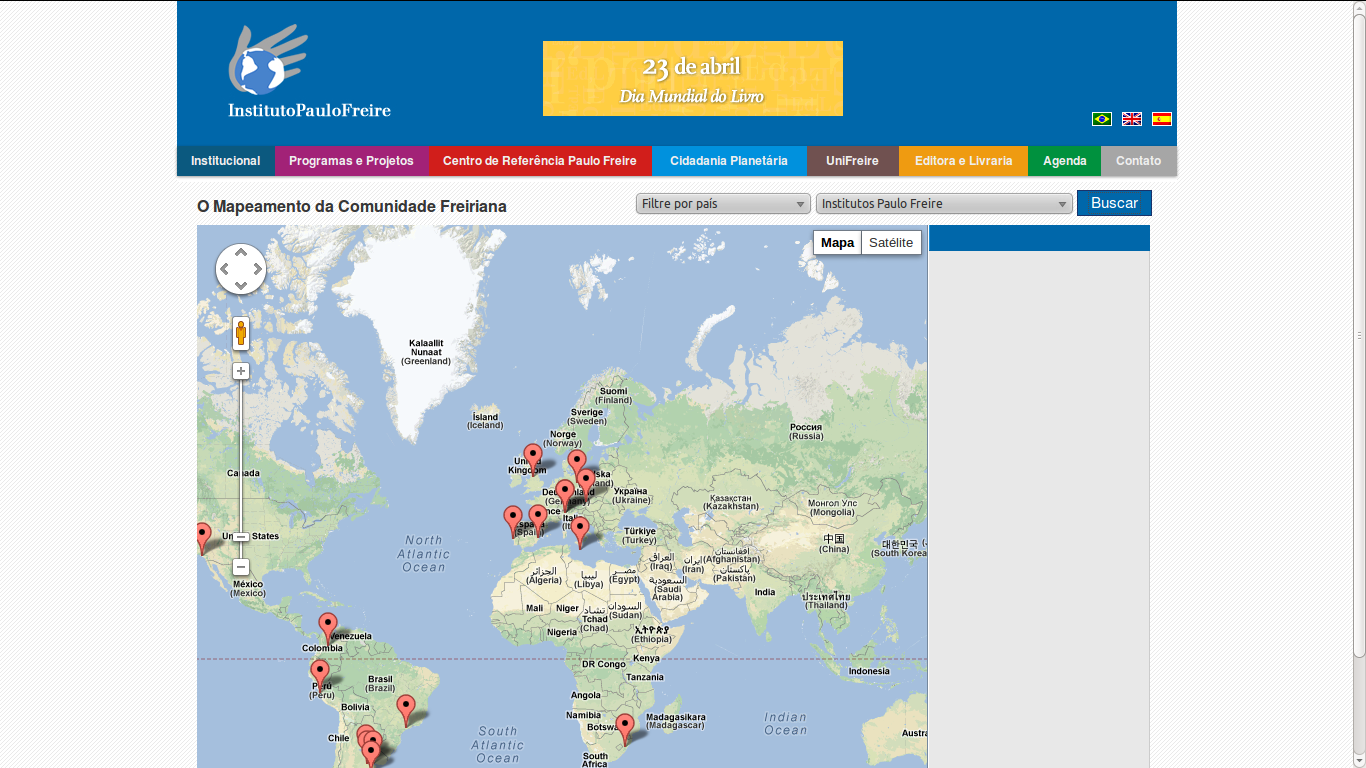 Combining these information that have arrived at the secretariat of UniFreire to previous mapping historic (that already collaborated with an initial frame – materials such as emails and cards in physical files about institutions and people around the world), it is already possible to access part of this corpus in the website http://www.paulofreire.org/unifreire/mapeamento-comunidade-freiriana. There is still many work for 2013 and the first time that the action was formally presented to the freirean community was at the Forum of Los Angeles, last year
Memory of the Forums – this action was and still is being coordinated and executed by UniFreire and had lot of emphasis during 2012, but still with remnants that need to be solved during 2013. such as the availability of many scientific articles presented or used in several editions of the event. It was also within the entity plan and is developed seasonally for a long time and consists basically to make available the possible max of products related to all editions of International Meetings of Paulo Freire Forum, such as videos of speakers’ speeches, banners, brochures and all graphic material that have available, the event programming, photos and publications. 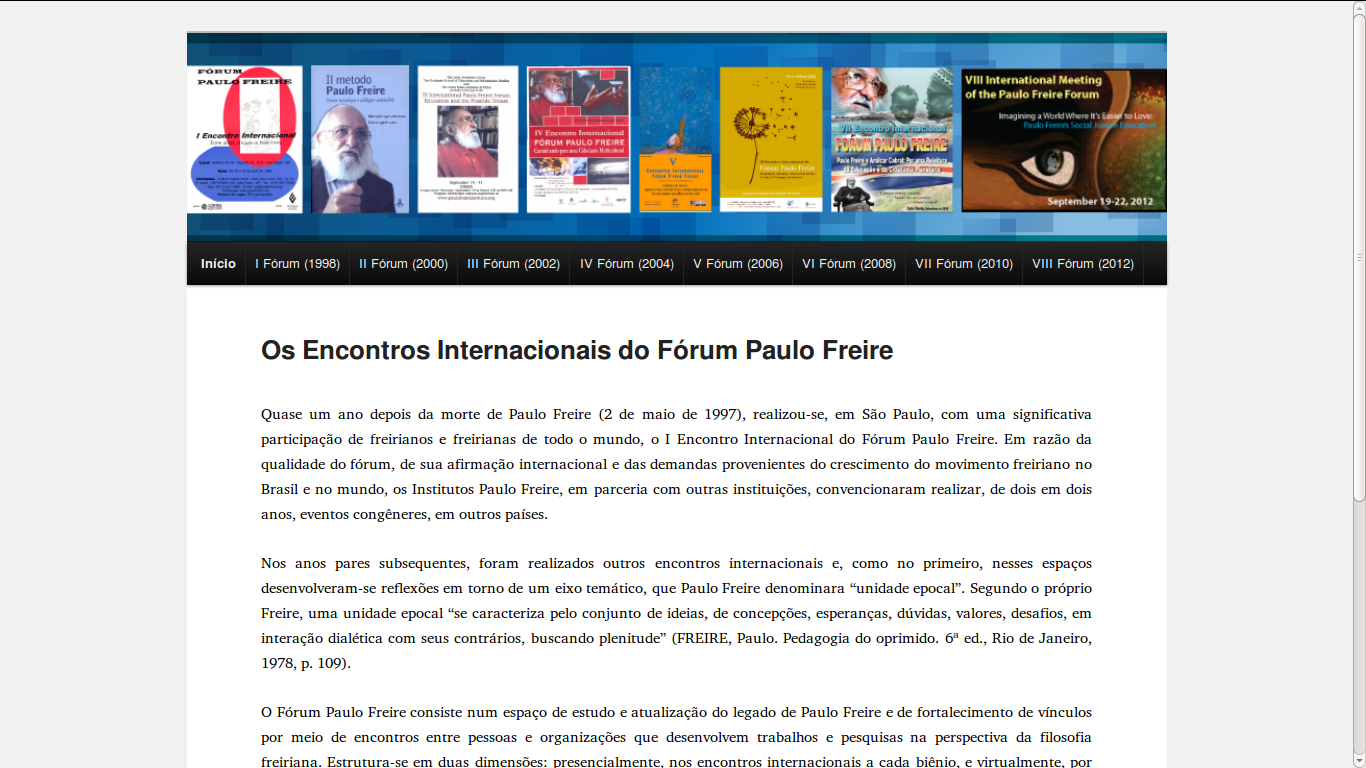 This action was already presented for the freirean community: the first time also was at the Forum of Los Angeles last year and can be accessed at the website http://forum.unifreire.org/. Also is of many interest of UniFreire team that the institutions which have other materials of Forums, unpublished for the website, that contact us for that we can dialogue on how we make to scan and make it available internationally. By the way, in this website is possible to find the Letter of Bologna (the document-certificate of birth mentioned above)
UniFreire Bulletin – More recognizable by freirean community because of the contact frequent that this action needed, the Bulletin is on its first edition, with a great number of matters and with the begging of people and institutions’ participation that, still locally and timidly, participated sending to us texts, photos and others subsides for that we knew and could reply more fully and respectfully what is happening in each place. The Bulletin was presented and discussed at the Forum of 2012 and after again it came back to be reflected, virtually, and has as proposal to articulate more effectively the international community specifically by its actions – interative, with multiple languages, subdividing in sections to contemplate a majority of the several natures of community work. The website is http://boletim-unifreire.paulofreire.org/
Other actions – In the Forum’s edition of 2012, UniFreire collaborated for that this edition would be the first to try a larger and precise virtual interactivity. The Forum was broadcast around the world and the world could communicate itself and be heard by and at the Forum. Another action that also is in the scope of articulation and that was effectively initiated is the opening of studies about Social Network at UniFreire, on its navigability and technological conditions and also on its potentials.
Paulo Freire insisted in the idea of “first we do, after we named it”. And, once he also reiterated that his proposal shouldn’t be narrowed to literacy, but should be a philosophical exercise and practice of think education in all spheres of life, we understand that the UniFreire project, therefore, in 2013, is more close that before of observe “(…) the following principles: learning precedes to teach and teach dilutes itself in the founding experience of learning; not do teach only contents, but to learn, this is, to think right; think right is to be always in doubt with the owns certainties, from observation of the world; the naive curiosity should be substitute by the epistemological curiosity”. (our emphasis)