 Portuguese
Francisca Pini
Alessandra Rodrigues dos Santos
MOVA-Brasil Project was created in 2003, inspired in the “Movimento de Alfabetização de Jovens e Adultos – Mova” (in English, Youth and Adults Literacy Movement). “Mova” was conceived by the educator Paulo Freire in the city of São Paulo, in 1989, when he was municipal secretary of Education. Based on the guiding conception of “Educação Popular” (in English, Popular Education), Paulo Freire aimed to promote a wide movement of literacy through the partnership between government and civil society.
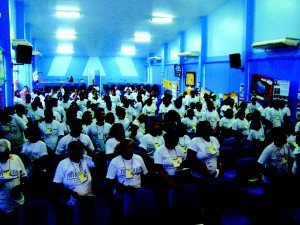
Meeting of students from MOVA in Manaus, Amazon, Brazil (September 2012)
During the ten years of its realization, were literate 192.445 students of ten states, in a total of 1.357 cities. Furthermore, the project formed 9.188 collaborators among monitors, administrative assistants, pedagogical assistants, pole’s coordinators and local’s coordinators.
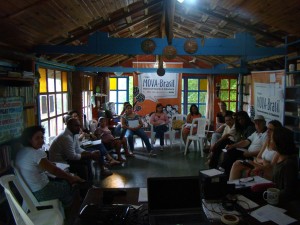
Continued Training of coordinators of pole in Pocinhos (MG)
In this stage of 2013, the project seeks to enlarge opportunities of access to education, promoting literacy of 25.240 youths and adults, besides to develop actions of mobilization and social intervention which aim the transformation of reality lived by the learners and contribute to the insertion of participants in the work world.
One of the axes which base the pedagogical work is the realization of continued training to all individuals that participate in the project. Because, according to Paulo Freire:
The education is an answer of the finite of the infinite. The education is possible for man, because he is unfinished and know himself as unfinished. This takes him to his perfection[...] On the other hand, the search must be something and must translate itself in be more: it is a permanent search of “itself”. (FREIRE, 2003, p. 27-28).
The ten Brazilian’s states which participate in MOVA-Brasil project and their partners have been challenge to systematize the “Projeto Eco-Político-Pedagógico – PEPP” (in English, Eco-Political-Pedagogical Project), which materializes the conceptions that found the process of literacy, citizenship, democracy, diversity and active participation, complemented with the “Leitura do Mundo” (in English, Reading of the World) – process which is lived by each state to ensure the recognize of particularities of each local, of the way to favor the main elements to the elaboration of an action plan that dialogues effectively with the social reality.
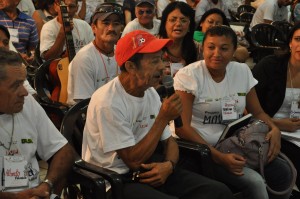
Meeting of students in Caucaia, Ceará State, Brazil (September 20
In these ten years of MOVA-Brasil, is possible to affirm that students have participated effectively, both in classroom and in the existing political spaces in the education of youth, adults and elderly. One of the participative processes formulated in the framework of Mova was the “Encontro de Educandos(as)” (in English, Students Meeting) that, since 2011, has been assured in state and municipal level as space of socialization, debates of public policies and construction of proposals to the upgrading of project.
REFERENCES
ANTUNES, Ângela; PADILHA, Paulo Roberto. Metodologia Mova. São Paulo: Instituto Paulo Freire, 2011. (Caderno MOVA-Brasil, v. 2).
_____; NERI, Juliana Fonseca de Oliveira; STANGHERLIM, Roberta. Economia Solidária. São Paulo: Instituto Paulo Freire, 2011. (Caderno MOVA-Brasil, v. 4).
FREIRE, Paulo. Educação e Mudança. Tradução Moacir Gadotti e Lílian Lopes Martin. 27. ed. Rio de Janeiro: Paz e Terra, 2003.