 Portuguese
PFIP – Paulo Freire Institute of Portugal divulged in its website information about one activity that it has in partnership with the University of Porto, with Paulo Freire’s Resource Center, with Lifelong Learning Programme – Education and Culture DG, with FCT – Foundation for Science and Technology – Ministry of Science, Technology and Higher Education and with the Center for Educational Investigation and Intervention: Intensive Program Erasmus. In IPFP website, they mention, especially, a meeting that was held in Rome, from 10 to 13 of January of this year, with representatives professors from each of participating universities in the project, to solve issues involving the frame of the new edition.
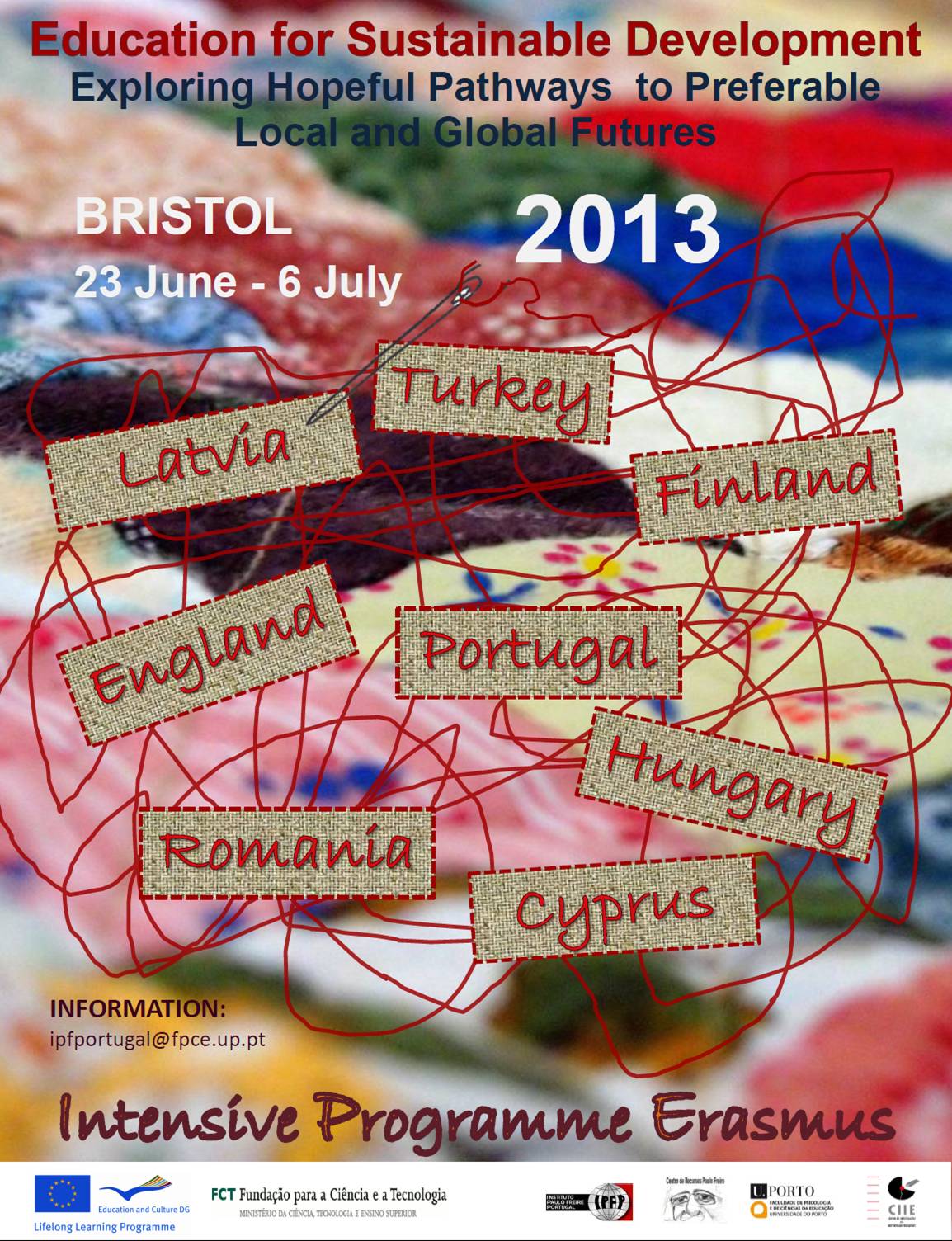
The 2013 edition of Intensive Program Erasmus will be held from 22 June to 06 July in Bristol, at the University of the West of England and is focused on Education for Sustainable Development: exploring hopeful pathways to preferable local and global futures. This program explores emerging policy for European region related to education for sustainability, including real-time search for answers to recommendations of UNESCO for the subject. The idea is to recognize social settings and institutions that offer access to understandings of sustainability and develop skills and ways of exploring multidisciplinary answers that contribute to sustainable development of all regions involved by the partnerships.
During these days, the selected students and teachers will be intensely building knowledge around the theme in a context of globalization, through an interdisciplinary approach in resolution of scientific problems, through investigation methods and intervention in problem-situations. They will explore widely contact with the ground – experiences and contexts, beyond the phenomenon itself that is the interaction with students (and cultures) from other countries and contact with culture and unique ways of life in Bristol. The students will still be able to use the experience as credits for faculty or as equivalence to an optative discipline of graduation.
Were able to apply until 31 January, 2012, students of 1st, 2nd and 3rd cycles of Sciences of Education and Psychology enrolled in FPCEUP – Faculty of Psychology and Educational Sciences of the University of Porto (for those interested in the program that have nationality Portuguese). 40 students will be selected from 08 European countries – Cyprus, Finland, Hungary, Latvia, Portugal, United Kingdom, Romania, and Turkey. Teachers and International specialists on the field of education for sustainable development, multicultural education and research methodologies of qualitative and quantitative character have also been able to apply.
The selection criteria were the knowledge and oral communication skills and written in English language, the interest in the theme, a good relational capacity – team collaboration, initiative, appreciation of differences, besides willingness to travel.
The evaluation of this formative process will happen in two steps: a Preparatory Work, this is, the elaboration in group of a research on an articulated experience with sustainable development in Portugal; and Participation, this is, how was the work in large group and medium group in national, bi-national and international teams (classroom and study visits). Also will be asked to the students an individual construction of a reflexive text.
The available contacts for further information on the course are emails of Paulo Freire Institute (ipfportugal@fpce.up.pt) and website of the European Comission (http://ec.europa.eu/education/erasmus/placement_en.htm).
Discussing autonomy with teachers…
Just not to lose the opportunity, Paulo Freire Institute of Portugal, at the end of last year, had one more of their actions successfully accomplished. There is a conference organized by FPCEUP and by the Center for Educational Investigation and Intervention called CAIR - Conference Applied Interculturality Research. 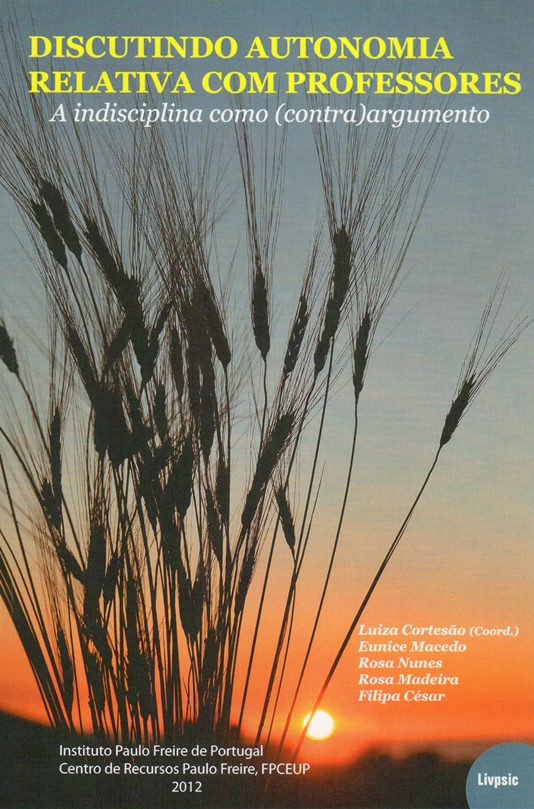 This conference is geared specifically for the study and diffusion of practices and intercultural researches and one of the focus of greater appreciation is the struggle against xenophobia and impacts of sectarianism in general. The first edition was very fruitful, according to the organizers of the event, and, for the second and last edition, the bet took place in the universe of Education, as an articulating theme.
Within the general programing of this 2nd CAIR, Conference Applied Interculturality Research, that happened at FPCEUP, on 23 November 2012, Dr. Professor António Magalhães was responsible for the presentation and comments on the book launched “Discutindo Autonomia Relativa com Professores – a indisciplina como (contra)argumento” (In English, Discussing Relative Autonomy with teachers – the indiscipline as a (counter)argument). This is one more edition of Paulo Freire Institute of Portugal and Paulo Freire Resources Center. Professor Luiza Cortesão is the coordinator of publication, which has also as authors Eunice Macedo, Rosa Nunes, Rosa Madeira and Filipa César. The book was published by Publisher Livpsic.