Portuguese
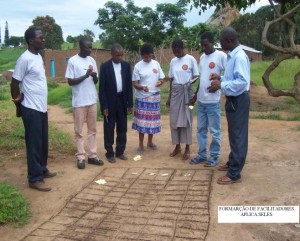
Formation of Facilitators
Headquartered in Luanda’s Province, in the city of Maianga, the “Associação Angolana para Educação de Adultos” (AAEA) works under the banner of Adult’s Education, especially when it comes to sociologically communities disadvantaged in many ways. The institution emphasizes the use of a methodological set called “APLICA/REFLECT” which even won the UNESCO’s Prize of Literacy in 2003, 2005, 2007 and 2008. It also develops projects, always of participatory nature, with the thematic of Literacy, HIV Education, Civic Education and Education on Gender. Among the geographical areas of intervention of the Association are, in Luanda’s Province, the cities of Viana and Cacuaco, in Bengo’s Province, the cities of Dande, Icolo and Bengo; and, in Kwanza Sul’s province, the cities of Sumbe, Amboim, Kibala, Porto Amboim and Seles. “APLICA”, therefore, and here is the news, is both in the urban area and coming to the Angolan countryside.
In 1993, a British NGO called Actionaid began a project to study the REFLECT, which has the main references Paulo Freire and the “Diagnóstico Rural Participativo – DRP” (in English, Participatory Rural Diagnostic – PRD). DRP is a mix of techniques and tools that make it easier for communities to conduct a self-diagnostic to, since then, create a management of their own planning and development. The Reflect on the other hand, is an acronym for Regenerated Freirean Literacy through Empowering Community Techniques, and developed in pilot projects in Uganda, Bangladesh and El Salvador. The evaluation of these varied experiences was edited by the Department for International Development (DfID) of the United Kingdom and reunited in 1996 in the Reflect Manual, subtitled ‘a new method for adult’s literacy and social change’.
“APLICA”, actually, is Reflect adapted to the Angolan reality, so the word “aplica” is also an exhortation to action, using the knowledge and skills acquired in and by the process which happens in the Circles. “APLICA” stimulates the learning of written language, but does not consider ignorant those who do not have.
How does work “APLICA”?
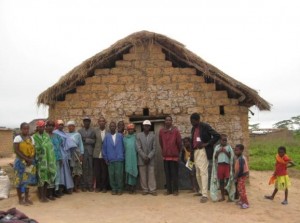
“APLICA” in the countryside
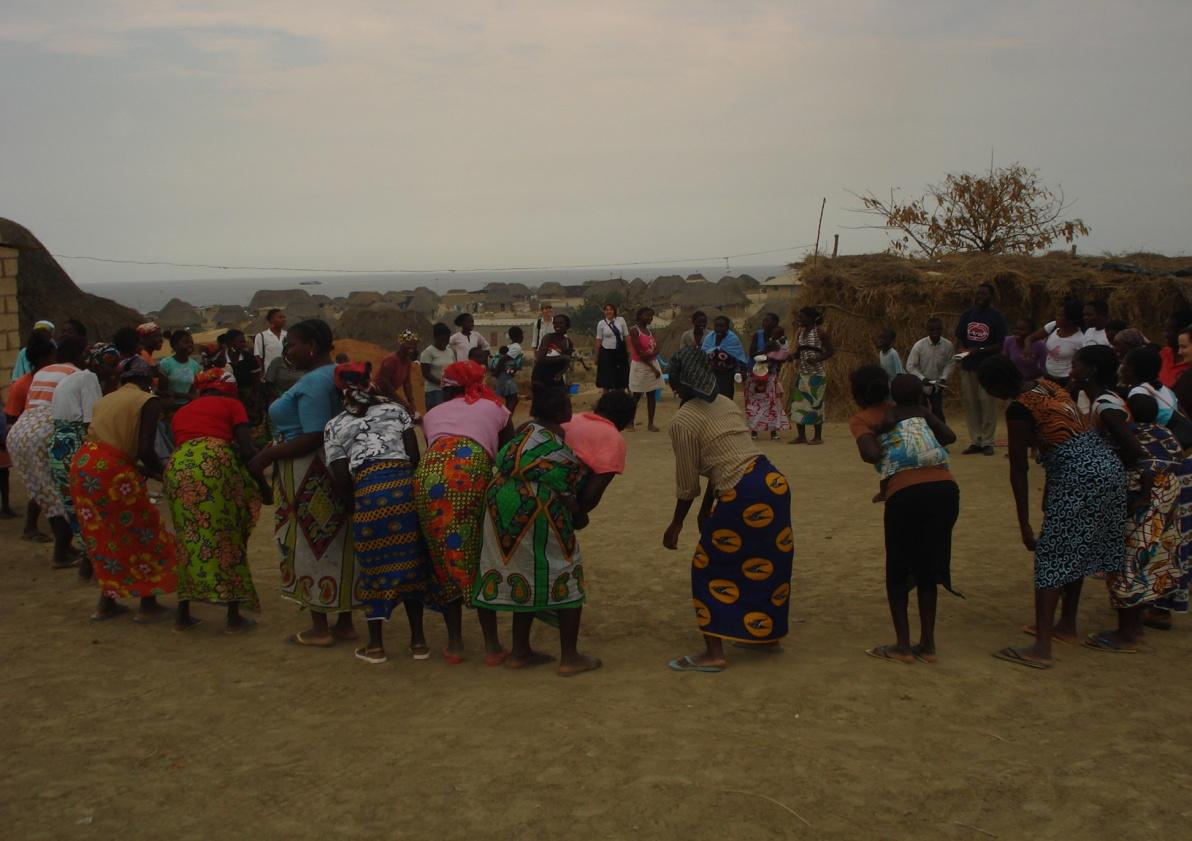
You’ve certainly seen already a scene like this, in some group inspired by “Experimento de Angicos” (in English, Angicos’ Experiment), in Rio Grande do Norte, Brazil: the participants, with some common identity features, are arranged in circles and not in classrooms; the atmosphere is informal and everybody can see everybody; the circle is guided by a community facilitator chosen by them and not a ‘teacher’, because he/she will teach and learn with participants; do not use a pre prepared manual or a primer and the contents are determined by the interests and needs of Circles.
The process begins with the facilitator encouraging the construction of graphics (maps, calendars, matrices), starting on the ground with concrete objects to stimulate the participation of everybody. Everything happens through dialogue and concrete questions/problematization about the lives of the participants. Paste what was done on the ground to a sheet of paperboard and identifies a word at the beginning or a phrase in the earlier process which functions as generator word or phrase, which will be broken down into syllables, that will be used for the formation of new words, most related to the context and needs of the group.
The fundamental principle of “APLICA” is the reflection-action, in other words, participants make reflections about concrete things of life and decide concrete actions to be accomplish, in relation to themselves, their family, the community where they live and to society in general. These actions should be related to the acquisition and increased power over them, to family (especially for women) and community empowerment through participation in decision making. According to the AAEA, the results they expect from “APLICA” is that people lose their culture of fear and of silence and be fomented the culture of dialogue and assume as individuals of their own development.
Angola has over 60% of illiterate adults and, to the specificity of these illiterate, the AAEA defends what it calls “functional literacy”, that is, a literacy that provides tools for the life (exercise of functions), when comes from the needs groups. The participants themselves will form words with the trend for which they are most familiar. A locksmith or other workers may form the word “FILE (tool)”, a woman who washes and hangs clothes can form the word “CLOTHES PEG”, many people may form the word “HUNGER” etc.
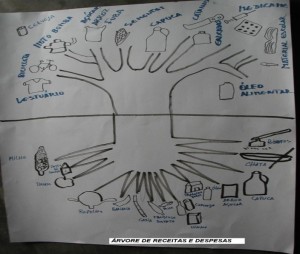
Recipes and expenses’ tree
The Reflect Global Appraisal of 2000 showed that the method was being used by more than 350 organizations in 60 countries. The objectives and focuses of the Reflect processes vary widely: emphasis on peace and reconciliation in Burundi, planning of the population’s level in India, accountability of the regional administration in El Salvador, land rights in South Africa, increase of competence to school’s management in Mali, mobilization around forest’s resources of the community in Nepal, organization of workers in tea plantation in Bangladesh, bilingual and multicultural education in Peru, until works on cultural identity in the Basque country (data taken from the website http://www.reflect-action.org/).
Besides the relationship between reflection and action, and therefore the lack of distinction between content and form, the Reflect processes are based on a series of principles and core elements derived, inspired, mixed, in the Freire’s work and thoughts: the problem of the relations of power and voice, of power’s awareness, of criticality; the political process and political nature in literacy/education; the deflagration of the methodological procedures from prior knowledge and experience, that is, roughly speaking, of the Reading of the World.
The main contacts in AAEA are Vítor Barbosa and Fátima Ramos and the available e-mail to contact the association is aaeadultos@netangola.com.