 Portuguese
 A possibilidade humana de existir
– forma acrescida de ser –, mais do que viver,
faz do homem um ser eminentemente relacional.
Paulo Freire
Chile was, as repported by one of the founders of Instituto Paulo Freire – Brazil, Professor José Eustáquio Romão, educator Paulo Freire’s “Academic Motherland”. It was in Chilean land that Freire wrote his books, “Education as practice of liberty”, “Extension or Communication” and, lastly, the one that had him recognized internationally, “Pedagogy of the Oppressed”.
Paulo Freire in Chile (1964-1969)
At the last edition of Bulletin Unifreire, this section described the process of “forced immigration” of educator Paulo Freire. Under custody of the Bolivian Ambassador, Freire left São Paulo in September, 1964. Few months after he arrived, Bolivia went through a political coup which made, in November, 1964, Freire find political asylum at Santiago, Chile.
As soon as he arrived in the country, the educator resumed his pedagogic practices, interrupted since his chase by Brazilian dictatorship, which had resulted in his prison for 70 days and, afterwards, exile. It was in Chile that Freire knew Jacques Choncol, vice president of Instituto de Desenvolvimento Agropecuário (INDAP) – Agricultural Development Institute. Choncol offered Freire a job in the institution. Freire also joined the Ministry of Education of Chile and was consultant of UNESCO gathered the Institute of Capacitación and Investigación in Agrarian Reform.
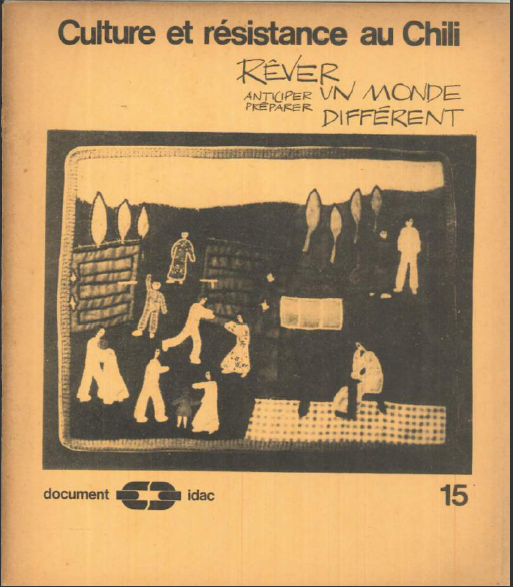
IDAC notebook cover, where Paulo Freire worked.
The work with peasants and agronomists in Chile resulted to the “agronomist-educator”, as Paulo Freire was called by Choncol, the preparation of the book: “Extension or Communication?”. During the reading, Freire approaches the relationship between agronomists and peasants. The observations made in Chilean fields strongly highlight what would become a central point in Freire’s writings, the oppression. The writer developed the conception, summarized in his work, watching the technicians standing as superiors in comparison to peasants. The peasants, at their time, had became “thing” due to the traditional agrarian structure. Once seen as “things”, the human beings turn themselves into maneuvering objects of the ones who have the power to decide the paths of their lives. It was with that purpose that Freire wrote “Extension or Communication?”, reporting the lack of communication of technicians with peasants and announcing the due to educative action in this relationship.
I was also in Chile that Freire wrote the book “Education as a liberty practice”, a continuation of oppression, dialogue and liberty analysis. During the reading, Freire defends the freedom of chains that prevents the social transformation and explicits the necessity to make choices: “Option for this yesterday, that means a society without people, headed by an elite superimposed to their world, alienate, in which the simple men, minimized and without awareness of this minimization, was more “thing” than men himself, or option for tomorrow.”
At Chilean field, Freire wrote the book that turned him known around the world as one of the main writers regarding education in service of the human being as a subject, that means, education being what maintains the structure,it is the most powerful weapon to dismantle what it supports. Thus, Freire wrote in his own hand, on single sheets, a book the would let him recognized around the world, “Pedagogy of the Oppressed”. The educator, in this book, puts not only the oppression as a central issue in his studies, but also the oppressed issue. It is this last one [the oppressed] that gets a starring role in the book which was unprecedented until that time in Brazilian literature.
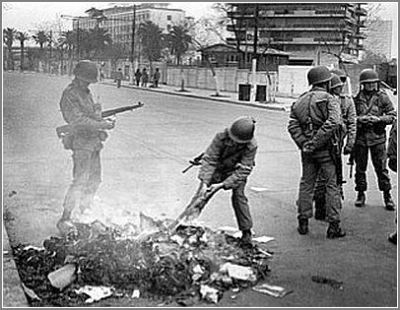
Chilean military burning books. Koen Wessing – Nederlands Fotomuseum.
Freire wrote the manuscripts in a politically troubled times in Chilean field. There were rumors that the educator has written a book against Chile, its population and dictator government of Pinochet. In order to deny rumors and guarantee his and his family safety, Paulo Freire invited his personal friends, Jacques Choncol and Maria Edy, to spend an afternoon at his home, exactly four years after his arrival in Chile. At the end of the meeting, Freire gave to Choncol a manuscript with a dedication to his friend. The letter written by Freire to Choncol can be read in Memory section of the 3th edition of this Bulletin. In the letter, Freire writes: “I wanted you to receive these manuscripts of a book that can be not worthy it, but that brings the deeply belief that I have in men, as a simple honor to whom I admire and I estimate.”
Taking the risk of being arrested and dead by Pinochet dictatorship, the educator left Chile in April, 1969.
The current context and Institute Paulo Freire – Chile opening
Still during 2015, Chile lives remnants of Pinochet dictatorship (1973-1987); Passing through a time of corruption reports, the president Nueva Mayoría promulgate in 27th April of this year the constitutional amendment that ends the neoliberal cycle imposed by constitutional devices of the ex-dictator. Besides requiring a minimum of 40% of female candidates and make flexible the formation of parties, the amendment abolishes the distrital- binomial system, which forced parties to join in coalitions because of the need to achieve 34% of votes to elect a candidate.
In the same period of extinction of authoritarian cycles in Chilean territory, it is commemorated the inauguration of the Institute Paulo Freire- Chile (IPF-Chile). The creation of the institution was approved during the last International Meeting of Paulo Freire Forum, held in Turin, Italy, in September 2014.
The launch of the IPF-Chile also means the presence of Freire in an extremely important country for the author, not only for his life but also for what Freire produced regarding to knowledge in Chilean territory. On the launch event, Professor José Eustáquio Romão says:
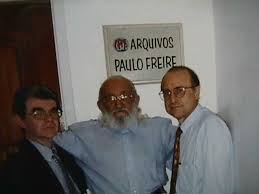
From left to right: José Romao Eustáquio, Paulo Freire and Moacir Gadotti, president of honor of Paulo Freire Institute – Brazil. Photo available in Paulo Freire Collection.
It was a very beautiful and exciting event. They created the Observatory of the Chilean Education Paulo Freire. I always thought that being the true “Academic Motherland” of Paulo Freire, the creation of IPF- Chile was late. However, as nothing is by chance, democratic revival that Chile is living, despite all the historic (neoliberal) trash that the dictatorship of Pinochet left to the country, they still struggles for the democratization of minds, this is the time for Freirian legacy to return to that Andean country.
To contact Institute Paulo Freire – Chile: direccion@piie.cl