 Portuguese
 Não haveria oprimidos,
se não houvesse uma relação de violência
que os conforma como
violentados, numa situação
objetiva de opressão.
Paulo Freire
Instituto Investigaciones Paulo Freire Rosário.
IPF Rosário works in an articulated way with Introduction to Philosophy and Social Sciences Chair III, searching to include a critical, ethical-political vision that allow to rethink the educative-formal order in which we are submerged and the national and regional conditionings which we are submitted to.
Through “ Articulated Educative Praxis: Problematic Configuration of professional profile at University” researching project, it was done cultural educative activities having as reference a freirian pedagogic proposal.
With the objective of contributing to the critical formation of students from a collective construction of professional profiles in an ethical-political perspective of Human Rights, speeches on common sense were faced with a “game” of inter educative relationships. In this way, it was identified challenges for another relation between “Knowing” and “Power”.
According to people responsible for the work, philosophizing problematizing text and context favors the searching for another power management in daily relationships: resignification that brings the “social reinvention” up. It is a methodological option in which it’s implicit the rescue of identities, the appreciation of popular knowledges that were not set and the recovery of the sense of otherness in daily life. “Work-action” just maintains itself in a listening exercise, articulation praxis and socioeducatives relationships.
IPF Rosário prioritizes methodologically the dialogical meetings through what they call “Rondas de Cultivaciones”. Organizing Culture Circles, educators favor the emergency of the lived world and its questioning, understanding it as an human project. Thus, the dialogues is able to prevailing, in a dynamics of creator subjectivity. They say: “There is no knowledge transmission, but construction of knowledge.”

Jor Ccia y TÉCNICA U.N.R. presentac poster Proyecto
During “Taller con alumnos de la Escuela Secundaria Nº 438 de la ciudad de San Lorenzo” (Sta. Fe. – Arg.) action, it was registered testimonials of some participants. As soon as they were questioned about what they expected of the Taller (workshop), they answered:
“ … that it would be a conference… we didn’t think that we would speak all the time, but that they would talk about themselves all the time. We could talk a lot.”
The utilized methodology was expanding the interest of students for the activity, in which nobody educated anybody, in which everyone educates each other, mediated by the world.
The proposal of working with students that have just entered at University, and, through workshops identifing the expectation that they have as soon as they finish a step in their lives and start another, is a way of provoking thoughts and also the construction of a sort of “scaffolding” that have generating questions on about ways of seeing the world that contribute with the formation of a critical posture. Rescuing the knowledge of young people, holders myths, brings the questioning of the “obvious”, of what can be found implicited in common sense and of what, because of that, seems to be unquestionable.
“Rondas de Cultivaciones” continues to be promoted by IPF Rosário in 2015, with open activities to the community: Origami workshops, literay workshops, re-readings in Portuguese workshops and semiotic reading of photographies, besides planning of “VI Interdisciplinary Course of educators formation. Voices and Places”.
According to the coordinators of the work: “Philosophizing in rights, questioning symbols and cultural metaphors instituted as unique, allows us new categories of thinking. It enables a local approach since the regional perspective of Human Rights in Our America.”
For IPF from Rosário, University can and must work problem-solving cores that today challenge us and force us to think about different lawyers and social actors have been done. For Lilians Mirtha Lópes, Institute director:
“ We join to the right that explicits itself as social practice, as ethical awareness of society, that defines as fight to which just one definition is not enough because there is always new demands, new basic necessities and new rights violation.”
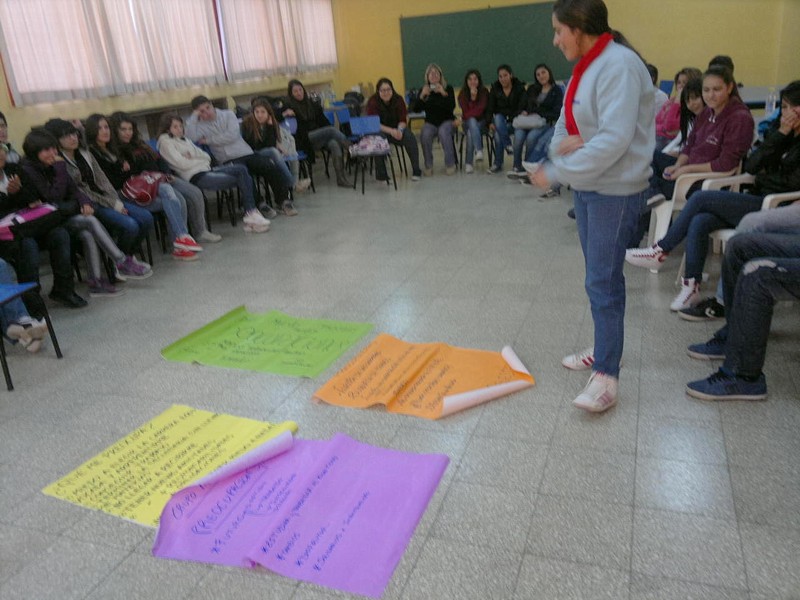
Taller con estudiantes, Escuela Media San Lorenzo
Thus, the education as daily praxis allows to reaffirm the belonging. They are “defenses” that result in a social practice linked to a solidarity networks generation, promoting new “rights/knowledge”, transforming the leadership live in memory.
Instituto de Investigaciones “Paulo Freire” works with the proposal of:
- Searching the construction of a research paradigm, in the big field of Social Sciences, linked to thoughts styles and action of people from its region, having “participant research” as a way to access the daily reality.
- Creating a participative and dynamic space among universities and communities.
- Developing a methodology that put individuals in a dialectical movement “conociendo-Nos/ conocer / y en la vuelta, reconocer-NOS”. A learning with and for the students of the University that favor the approach of graduated young people into the teaching and research field.
- Making that students and teachers feel as active subjects in the construction of Professional Profile and Power – and of the inter relationship between the two of them – standing as citizens.
Content sent by Lilians Mirtha López of Instituto de Investigação Paulo Freire Rosário: catedratres3@gmail.com
Blog: ipf-rosario.blogspot.com.ar