 English
“More than be a student because some reason, the student needs to become student by considering him/herself as a expert subject and not as an incidence of educator’s speech.”
(Paulo Freire, Pedagogy of Hope)
On January 31, 2014, Vitor Barbosa, president of the Angolan Network of Civil Society of Education for All, participated in an interview for the radio program “Angola Fala Só”. Vitor is a professor, but he prefers to identify himself as freirean educator, following the logic “not an educator to the student, not a student for the educator but an educator-student and student-educator. Nobody educates theirrselves, nobody educates the other, people educate each other in their interaction mediated by the surrounding ” by Paulo Freire.
Vitor pointed out the importance of investment in early childhood education. The educator says that children who are able to attend educational institutions from 3 to 5 years, developed a number of skills and competencies that allow to break the barriers to learning of the following series, reducing repetition rates. He also stressed that children who grow up in an environment in which parents read and write, are predisposed to succeed in school life.
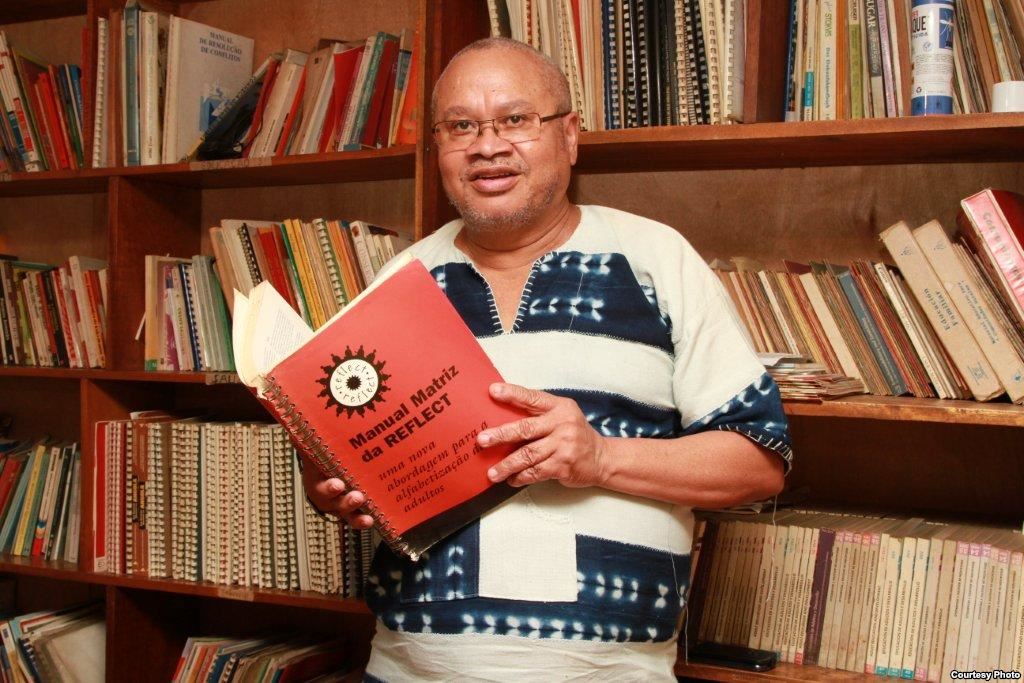
Vitor Barbosa, president of the Angolan Network of Civil Society of Education for All
However, it is not only in the perspective of reading and writing that education should be thought. In this sense, the president of the Angolan network said that the function of education is not only to prepare for the job market. According to him, it has a broader role, the one about teaching values such as respect and other more. It needs to be able to connect what you think with what you feel, to go beyond schooling, to form citizens. The educator, to achieve this goal, must be supported on three pillars, their self-esteem, status conferred on them by society and constant professionalism. For this reason, it is important to encourage contact between rulers and ruled and realize what Freire was appointed in The party as an educator-student: “It is as impossible to deny the nature of the educational process as deny the educational character of the political act.”
Educational reform in Angola, which has been implemented since 2002, was also marked in Vitor Barbosa’s speech. Before the reform only the first series, the first to fourth one, had only one teacher for all subjects. Currently, fifth and sixth series is also the responsibility of a single teacher, which was a source of criticism by one of the listeners. The representant of the Angolan Network of Civil Society of Education for All stressed the importance of having dialogue permanently between all involved and interested in education. In his view, the problem is not in Angola, but in learning how to teach.
Among other points, finally, Vítor Barbosa spoke of the need for greater participation of women in education, not only in unions, but in their various fields and quoted Nelson Mandela, stating that education is a weapon to make the world more worthy, fairer. It is not a tool to make a citizens superiors to each other, but perhaps more responsible. Citizens that communicate constantly with each other to build educational reforms that include everyone.
More information about the interview can be found in:
http://www.voaportugues.com/content/angola-fala-so-bilhete-de-identidade-vitor-barbosa/1839784.html – “Angola Fala Só: Vitor Barbosa card of identity ”
Radio: http://www.voaportugues.com/audio/audio/371372.html