 English
“I’ll be preparing your arrival
as the gardener prepares the garden
to the rose that opens in spring“
(Paulo Freire, Genéve, 1971)
Between the 5th and 7th November, 2013, it happened in Nove de Julho University (UNINOVE), the IV International Seminar on Education which had the theme “Paulo Freire and Higher Education.”. The event counted on the participation of Jacques Choncol and Marcos Guerra, speakers of Magna Conference entitled “Agrarian Reform in Chile and Peasants Education”. José Eustaquio Romão and Moacir Gadotti, both members of the National Committee of the Project “Paulo Freire: Angicos, 50 years”, participated in the donation of Pedagogy of the Oppressed manuscript in Brazil. Teachers Antonio Teodoro and Manuel Tavarem launched Lusophone Magazine. Besides the participation of Carlos Alberto Torre (UCLA, USA), Ana Maria Saul from PUC-SP and Celso de Rui Beisiegel from USP who discoursed on the subject of popular education and the university.
At the opening ceremony in the auditorium from Campus Memorial, the “return” of the manuscripts of the book Pedagogy of the Oppressed, written by Paulo Freire during the time he was exiled in Chile, was performed. They were in possession of Choncol, ex-minister of agriculture from Chile, to whom Freire had confided his work. “I would like you to receive these manuscripts of a book that may not be worth it, but it embodies the profound belief that I have in men, as a simple tribute to whom I greatly admire and cherish,” wrote Paulo Freire to Choncol and his wife, Maria Edy.
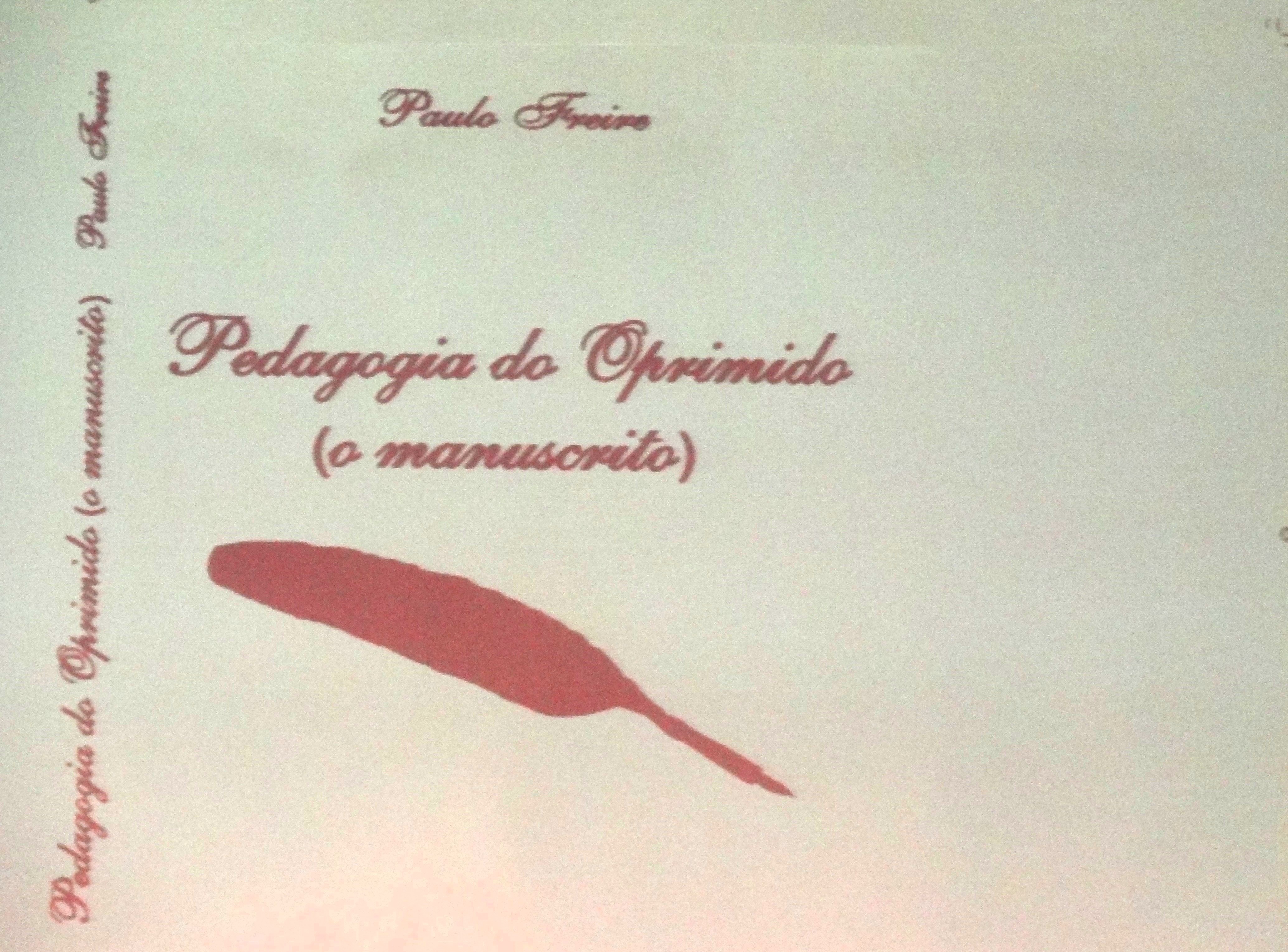
In an interview with TV Giro, from UNINOVE University, Choncol talked about the path taken by manuscripts until they reach Brazil, “When there was the military coup in Chile, the manuscript was in my house, the militaries came in, but they did not give importance to it. My mother, afterwards, recovered it and sent it to France, where I stayed in exile for many years (…). After I returned to Chile and I took it with me. Now I bring it here, to Brazil, where it deserves to be, (…) in order to be a tribute to whom he (Paulo Freire) was and what he meant to so many people. “
Manuscripts, as said by Paulo Freire Institute president of honour, Moacir Gadotti, represent an innovation of the author references, with drawings and unpublished notes. They also represent an educator’s dream, to review the scriptures that came out of his hands in 1968. Personal friend of Paulo Freire, Gadotti tells that the educator was concerned about the possibility of his book be confiscated by the militaries. So, before he gave it to Choncol, he typed the manuscript and made several copies.
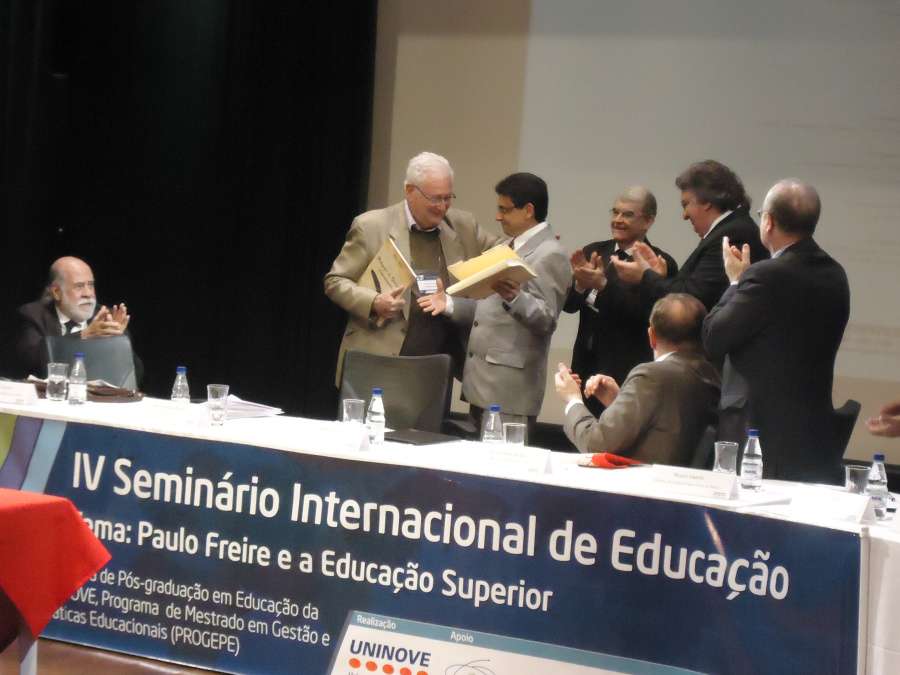
Jacques Choncol gives the manuscripts of the book “Pedagogy of the Opressed” to Lutgardes Freire, Paulo Freire’s youngest son, in the IV International Seminar on Education.
In “IV International Seminar on Education” was also held the last ceremony to commemorate 50 years of experience developed by Paulo Freire in Angicos. Started on January 18, 1963, the experience has put in place a method of literacy for youth and adults people different of commonly used to teach children. Among the 380 students who started the course, 300 participated in the final ceremony of diplomas. They were literate. From then it has consolidated the “Paulo Freire method”.
The handing-over ceremony of the manuscripts to Brazil was coordinated by the National Committee of the Project “Paulo Freire: Angicos, 50 years”. “Today is a special day for all freirean people, especially for us brazilians. The original manuscripts of Pedagogy of the Oppressed are reaching Brazil for the first time.” said prof. Gadotti. This is one of the most sold books around the world, translated into about 25 languages, written by the one chosen to be the patron of the Brazilian education.
The Pedagogy of the Oppressed manuscripts were donated to the Ministry of Culture in February 2014. The minister Marta Suplicy received them at a hearing, in her office, directly from the rector of Nove de Julho University, Eduardo Storópoli, and its director of graduate Jose Romão. Finally, the document will be forwarded to the National Library, where it will be next to the greatest works in the history of the Brazil Foundation.