 English
“I’ll doubt of those who will say to me,
quietly and cautious:
It is dangerous to act
It is dangerous to speak
It is dangerous to walk
It is dangerous to wait in the way you wait,
because these refuse the hapiness of your arrival.”
(Paulo Freire, Genéve, 1971)
2014, the year of the fiftieth anniversaries
In ‘Community Highlight’ section of this bulletin, it was reported the arrival of the manuscripts of the book “Pedagogy of the Oppressed” to Brazil. Paulo Freire outlined his writings while he was in exile in Chile in Santiago, during 1968. That same year, the dictatorship was installed in the country and, afraid that the manuscripts were confiscated by the militaries, since it was rumored that the Chilean government was looking for a “subversive and dangerous” text, the educator gave them to Jacques Choncol, director of the Chilean Institute of Agrarian Reform (ICIRA), where Freire worked. In the letter given to Choncol with the book, he refers to the stalker character of civil-military dictatorship that had settled in Brazil in 1964:
Dear friends , Jacques and Maria Edy ,
It has been exactly four years since I came to Chile . I left Elza, our children, I left a little old astonished lady at what seemed impossible to understand .
I left Recife, its rivers, its bridges, its streets with delicious names – Saudade – Union – 7 sins, Creoulas street, the Cry Boy street, Friendship
Street, the Sun Street, Aurora Street. I left the sea of warm water, the wide beaches, the coconut trees .
I left the sellers street: banana and guava candy! I left the smell of the land and the people of the tropics. I left friends, known voices. I left Brazil. I brought Brazil. I arrived (in Chile) suffering the split between my project and my country project.
I found you. I believed in you . I engaged with your commitment INDAP that you have shared.
I wish you received these manuscripts for a book that can not be worthy, but it embodies the profound belief that I have in men , as a simple tribute to whom I greatly admire and cherish .
Santiago,
Spring 68.
Paulo “
Today, fifty years after the establishment of the military government in brazilian territory and after the exile of Paulo Freire, the ‘Memory’ section of this bulletin reminds the educator’s trajectory during the moments preceding the coup of 64, it reminds also the institution of the National Literacy Program from Education and Culture Ministry which lasted 83 days.
The moments preceding the coup and Paulo Freire
João Goulart became president of Brazil in 1961, still in parliamentary regime. In 1963, a feferendum was approved the option of presidentialism and, from this point, a new ministry had been formed. “Jango”‘s mandate was marked, beyond the coup of 64, for policies focused at people considered of lower class. In reality, the early 60s was a hectic time, with fanfare of “subversion of order” made by the national and international dominant class, in face of demonstrations led by urban and rural workers and sections of the middle class, charge of “discipline and hierarchy break” inside the Army and “authority crisis”of the State itself. Amid the political and social upheavals in 1963, Paulo Freire applied, for the first time, his teaching method for young and adults people in Angicos, Rio Grande do Norte.
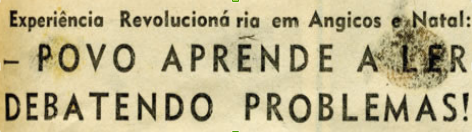
The experience was considered a success. 300 students were literate in 40 hours. In the presentation of diplomas, it was noticed the presence of General Humberto de Alencar Castelo Branco who would have said to Calazans Fernandes: “Young man, you’re getting fat rattlesnakes in these hinterlands”. It was possible to noticefrom there the introduction of the “commonization” fear of the country.
Paulo Freire continued his journey in favor of liberating education, an education that not only literate the student, but also allows them to read the world where he belongs, because “it is not enough to read mechanically ‘Eva saw the grape’. It is necessary to understand what position Eva occupies in her social context, who works to produce grapes and who profits from this work” said the educator.
Thus, on January 21, 1964, João Goulart institutionalized “Paulo Freire Method” through the National Literacy Plan (NLP).
DECREE No. 53,465, FROM JANUARY 21, 1964. (Literal Translation)
It establishes the National Literacy Programme of the Education and Culture Ministry and other provisions.
THE PRESIDENT OF THE REPUBLIC, using the powers contained in article 87, paragraph I, of the Constitution, and
CONSIDERING the need for a concertrated national effort to eliminate illiteracy;
CONSIDERING the efforts made so far have not matched the need for mass literacy in the national population;
CONSIDERING that it urges to call for action and to unite all classes of the brazilian people in bringing the alphabet to those most disadvantaged who still are unaware of it;
CONSIDERING the Education and Culture Ministry has been proving, through the Commission of Popular Culture, with the advantage Paulo Freire Literacy System in quick time,
DECREES:
Article 1º – It is established the National Literacy Program, by using Paulo Freire System through the Education and Culture Ministry.
Article 2º – In order to implement the National Literacy Program, under the preceding Article, the Education and Culture Minister is going to form a special committee and take all necessary steps.
Article 3º – Education and Culture Ministry is going to choose two areas in the National Territory for start of the operation of the program mentioned in this Decree.
Article 4º – The Committee of the National Literacy Program is going to call and to utilize the cooperation and services of: student and professional associations, sports associations, societies and neighborhood municipalists, religious organizations, governmental, civil and military associations, employers’ associations, private companies, agencies diffusion, teaching and all mobilized sectors.
Article 5º – It is considered relevant provided services to the mass literacy campaign conducted by the National Literacy Program.
Article 6º – The development and implementation of the National Literacy Program are going to be conducted by the Special Committee, mentioned in Article 2º.
Sole Paragraph – The Minister of Education and Culture will issue in due course, ordinances containing the rules and instructions for operation of the Commission, as well as for development of the Programe.
Article 7º –All opposing dispositions shall be revoked.
Brasília, January, 21 1964; 143º year of Independence and 76º year of the Republic.
JOÃO GOULART
Júlio Furquim Sambaquy
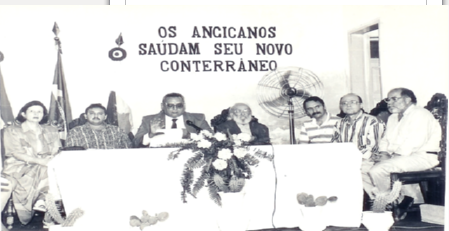
Paulo Freire in Angicos, 30 years after his experience. This photo is from “Photos” section of Paulo Freire Collection.
http://www.acervo.paulofreire.org/xmlui?locale-attribute=en
83 days of the National Literacy Program – the 1964 coup
The program has foreseen the creation of 60.870 culture circles, in all units of the federation, to alphabetize, in the year of its implementation, 1.8342 million illiterates, between 15 and 45 years. The project has actualized by pilot projects in the South, Southeast and Northeast. However, the states have barely initiated the actions of the National Literacy Program (NLP), the civi-military dictatorship was installed in Brazil in April 1, 1964. The military action happened in response to claims by socioeconomic changes that aimed at extending the democracy inside the State and reforms in national capitalism. The coup was supported by brazilian business community, formed by the industry, by the big mass media companies and multinationals, and some sections of the middle class, as small traders and catholic women’s organizations. The coup , which aimed to “restore order in Brazil” destroyed political organizations and suppress social movements. After 14 days of regime , the NLP was repealed.
DECREE N.º 53.886, FROM APRIL 14, 1964. (Literal Translation)
It repeals the decree n.º53.465, January 21, 1964, which established the National Literacy Programme of Education and Culture Ministry.
THE PRESIDENT OF THE HOUSE OF REPRESENTATIVES, as PRESIDENT OF THE REPUBLIC-IN-OFFICE, using the powers set forth in Art. 87, paragraph I, of the Constitution and
CONSIDERING the need to restructure the planning for the elimination of illiteracy in the country;
CONSIDERING further that the material to be used in the National Literacy Population shall present clearly democratic ideas and preserve institutions and our people’s traditions;
CONSIDERING, finally, that the National Department of Education is the agency of the Education and Culture Ministry which is responsible, by law, for the administration of the education affairs,
DECREES:
Article 1.º – It is repealed the Decree nº 53.465, from January 21, 1964, which established the National Literacy Programme of the Education and Culture Ministry.
Article 2.º – The National Department of Education is going to collect all the acquis employed in the implementation of the National Literacy Program, whose resources are going to be also available to that agency.
Article 3.º – The Education and Culture Minister is going to approve the necessary acts for the implementation of this Decree.
Article 4.º This Decree shall enter into force on its publication date.
Brasília, April, 1964; 143º year of Independence and 76º year of the Republic.
RANIERI MAZZILLI
Luiz Antônio da Gama e Silva
The fiftieth anniversary
2014 is an emblematic moment for the freirian community and for Brazil. Five years after Paulo Freire’s official “amnesty”, we live the fiftieth anniversary of the regime that criminalized the educator and made him a political refugee. This year marks the 50th anniversary of both the implementation of the National Literacy Plan, which was based on the Paulo Freire’s experience in Angicos, and its repeal during the civil-military coup of 1964.
“Celebrating is to keep alive the fight and to announce achievements.” (Moacir Gadotti).
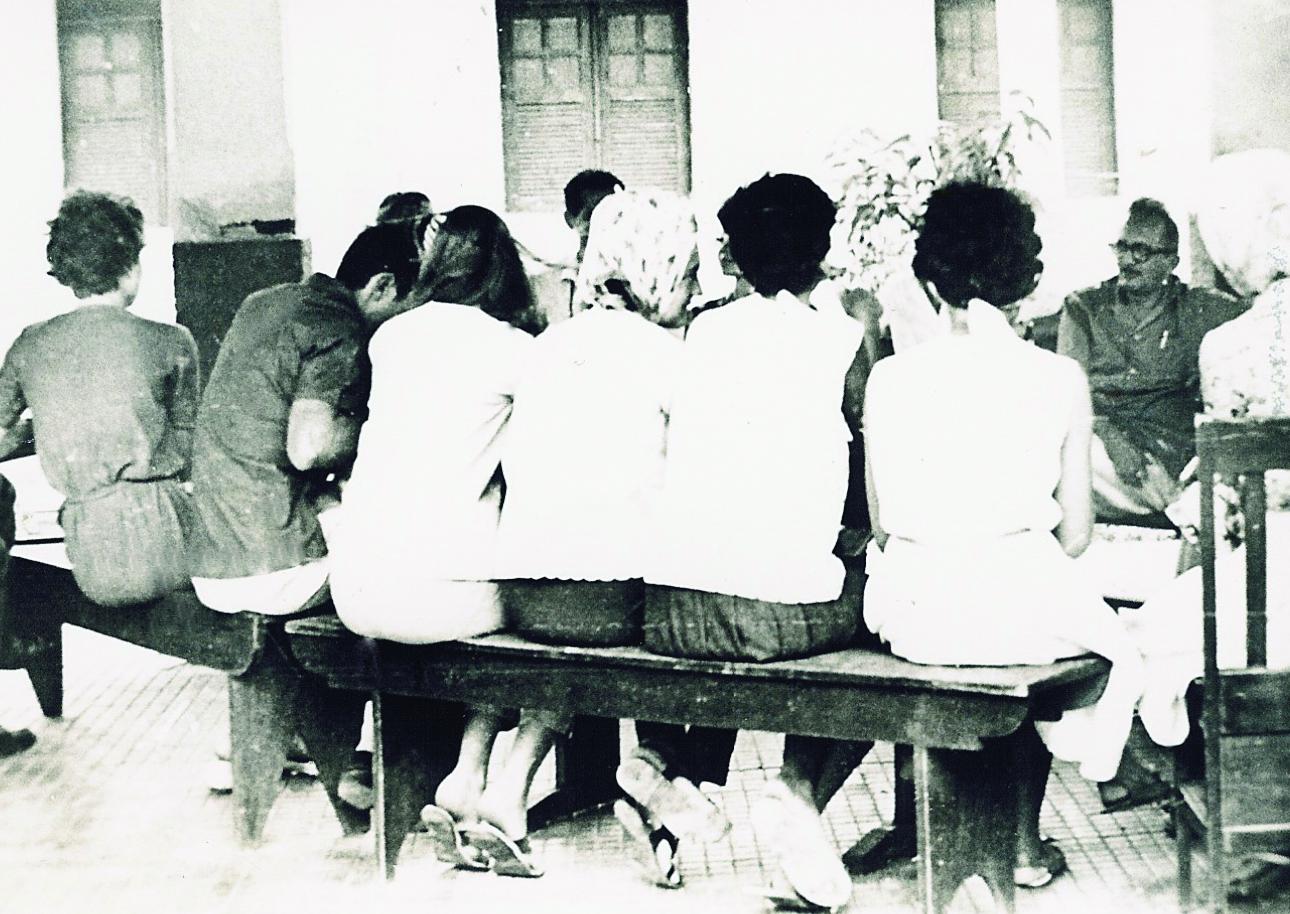
Paulo Freire in the Culture Circle in Angicos