 English
“Education as a practice of freedom, unlike that one which is the practice of domination, implies the negation of abstract man, isolated, loose, off the world, so also in denial of the world as a missing reality in men.”
(Paulo Freire, Education as the practice of freedom)
In September 2013, indian Paulo Freire Institute organized a national seminar to commemorate the 93º educator Paulo Freire’s birthday, which had the theme: “Society, State and Education in India: Critical Issues from Freirean perspective.” On days 19 and 20, ninety-two Indians attended the meeting, divided into four parts: the inaugural session and three technical sessions.
The inaugural ceremony was introduced by a song played by the cultural group of students from the Sitakulchi college where the event happened. The principal of the college, Dr. Prabhas Chandra Samanta pointed to the fact that despite Freire’s educational philosophy have caused great impact on the world, it is not well known among indian educators. In this sense, Paulo Freire Institute from India, inaugurated in 2004, has given lectures, seminars and diverse backgrounds to fill the gap.
The seminar sought to reflect on the exigency for quality education in the country understood as a human rights issue and point the convergence of ideals between Tagore and Freire. From this perspective, after Dr. Samanta’s speech, the historian Prof. Ramprasad Pal talked about the importance of a participatory education, in contrast to the neoliberal model of education, especially in India, where the educational structure is not popular. The inaugural session ended with a speech from the honorary director of the Paulo Freire Institute from Bengal, Dr. Afzal Hossain, reading messages from different Paulo Freire Institutes, including Dr. Moacir Gadotti and Carlos Alberto Torres.
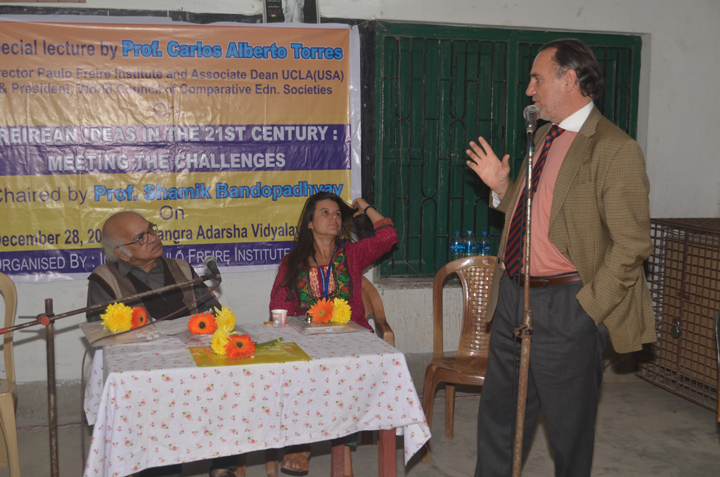
Dr. Carlos Alberto Torres delivering a Special lecture on Freirean Ideas in the Twenty-first Century : Meeting the Challenges
The first technical session was chaired by Dr. Prabhas Chandra Samantha. There were two papers presented for reflection: “Women’s Education in India : An Unfulfilled Task” written by Mr. Shakti Mandal, Chairman and Satyen Maitra Janashiksha Samity and “Democratic Method of Teaching: The Formal Context”, written by Dr. Supam Mukherjee. The first text points indian government’s disinterest in investing in women’s education, highlighting the fact that India is the country that has most illiterate women in the world. The main focus of the second text, in turn, was the educational method of the primary to the university. According to the author, the way to teach the learner is always underestimating it, which can cause negative effects in their formation.
The second technical session was coordinated by Dr.Afzal Hossain. The papers presented were written by Biswajit Gayen, a researcher at the political department of the school and Dr Khairul Anam, associate professor. The first text presented was entitled “Fundamentalism in Bangladesh and its Impact on Education and Society: Analysis from Freirean Perspective”, exposing the origins and developments of the conflict between the fundamentalist forces in Bangladesh in all aspects of life, including education. Later, Dr. Khairul Anam exposed her text “Developing quality in Education: Importance of Moral Value”, which sought to point out the constant degradation of education of young people in India and the importance of basic education.
The third technical session was the presentation of four papers: ‘Human Right and Present Education in India: A Critical Review from Freirean Perspective’ by Mr. Shyamal Mandal, “‘Role of Mass Education in Community Development in India’ by Mr. Anindya Sundar Chaudhury, “A Comparative Discussion on the Thinking of Tagore and Freire on Mass Education” by Dr. Debasish Mandal and ‘Women’s Education in Bengal During 19th Century: Perspectives from Tagore and Freire’ by Dr. Jayanti Mandal. The seminar ended with a reading of Dr. Afzal Hossain on “Education as Human Rights in the Indian context.”