 English
Não é no silêncio que os homens se fazem,
mas na palavra, no trabalho,
na ação-reflexão.
Paulo Freire
During the second half of 2013 it was conducted in a Municipal School of Early Childhood Education (EMEI), located in the south of the city of São Paulo, a research-intervention involving six teachers who were part of the teaching group EMEI. The research aimed to assign new meanings and directions to the continuing education of teachers who work with children 4-5 years and as a theoretical and methodological fundamentals of action-reflection-action, recommended by Paulo Freire.
Freire (2009, p.117) highlights the importance of reflection on educational practice saying,
Clarifying a point here naked and there, it needs also to be unveiled. This is the dynamics of the process of thinking about practice. That’s why we think the practice teaches to think better, just as teaches to practice better.
Based on this assumption, the researcher, who serves as educational coordinator in the universe of the research school, used strategies for the practice itself is transformed into individual and collective reflection object, in order to redirect educational activities.
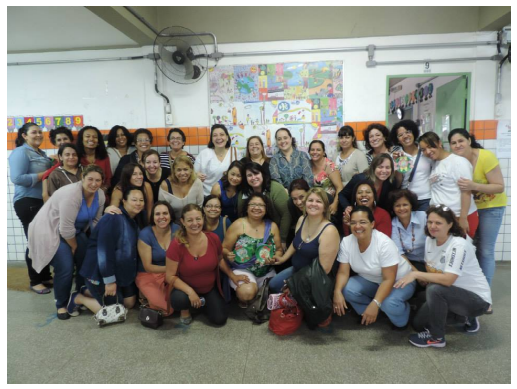
Group of researchers at the University Nove and teachers.
The research began when I joined the Master in Management and Educational Practices of the University Nove (UNINOVE), and elaborated a project in the initial uneasiness pervaded the need for reflection and discussion about continuing education for teachers in service city of São Paulo happens and what are the contributions of this in practice of teachers of early childhood education.
Not uncommon is how often the moments of training in schools have been busy with reports, document filling, organizing events, readings schedules for compliance and other “bureaucratic activities.” Given this reality, it is crucial that changes occur in the practice of educational coordinators that are ahead of formative processes within schools as well as in the practice of teachers, taking as their own training authors. We need to rethink the moments of training so it has based on the reflection on practice and involve (the) teacher (o) for this (e) actively participate in this process.
For the development of intervention research stages were developed that favored the process of action-reflection-action, recommended by Freire. The strategies developed for the unveiling, the questioning and reflection on the practice were: dialogue with the teachers on planning of activities with the children; observation of the realization of the proposed activities; dialogue with each of the pairs of teachers of the observed rooms and socializing with other teachers during the times of formation of JEIF group (Special Day of Integral Formation), records and reflections systematized after the feedback session with the double. At all stages, the procedures used were: written record in a field diary; record of observations made by the researcher/coordinator; audio records and transcription of the material; preparation of summaries of conversations conducted in times of fed back with the double.
The research had as axis the use of the teaching practice record. I, as a researcher-coordinator, recorded activities that watched – with pictures and considerations/questions to be shared with teachers – and they recorded the activity plan and the comments made during this. From the socialization of records, summaries were made that were shared with a larger group of teachers, enabling new thinking. These reflections contributed to practice with the children and the professional growth of the teachers and the educational coordinator.