 English
“Aos esfarrapados do mundo e
aos que neles se descobrem e,
assim descobrindo-se, com eles sofrem,
mas, sobretudo, com eles lutam.”
Pedagogia do Oprimido, Paulo Freire
What is lost during dictatorial regimes?
Freedom of expression, communication, production, social participation, democratic management and right to the city, the country. But not only.
In dictatorial times, the country turns against his own society. If, in Brazil 24 years ago, the Civil Military Dictatorship left irreparable losses related to the fight against illiteracy, exiling the educator Paulo Freire, in other countries, the exile still aborts political struggles beyond measure.
The year 2015 has barely begun and already is marked by countless deaths of citizens who try to cross the Mediterranean Sea escaping from dictatorships that devastate their countries. About 1.800 people, coming from Africa and the Middle East, died in the Mediterranean this year in an attempt to reach a “safe haven” where the right to life is respected. Men and women were forced to flee from countries such as Syria, Mali, Eritrea and Somalia, for example, expelled from their territory by war, political persecution, religious and ethnic.
According to data released by the United Nations High Commissioner for Refugees, 218.000 refugees and immigrants crossed the Mediterranean Sea in 2014. The illegality of migration act of this huge number of people puts them in the category of refugees. Played on their own, they leave their countries in order to prolong their lives, threatened in their countries of origin. Situation similar to that experienced by Paulo Freire when he was forced to leave Brazil, in September 1964.
Paulo Freire, forced immigrant
Born in Recife, September 19, 1921, Paulo Freire has always been “very acclimated to the northeastern culture,” as his son Lutgardes Freire tells. At 10 years old, the educator moved to Jabotão and grew up there. He tells, in reports made to Moacir Gadotti, personal friend of Freire, that as he saw his body grow, also felt his passion for knowledge increase.
In January 1964 Paulo Freire launched in Brasilia the National Literacy Program – NAP (see more details in the Bulletin Unifreire edition 3 – 2014, the year of cinquentenários). The program was the translation of passions, of loveliness and solidarity of the teacher towards his homeland. It had previwed to achieve five million illiterated brazilians, however, 83 days after its signing, settled in Brazil the dictatorial regime and, with it, the persecution of all those who were engaged with ideas contrary to the order of the day. From April to September 1964, Paulo Freire was forced to go to the Rio de Janeiro to meet military police investigations. Thus, under threat of being arrested and tortured, the educator exiled himself in Bolivia at first.
Freire’s forced migration caused enormous and immeasurable losses to the social, cultural and educational evolution of Brazilian society. The political struggles of which he was in were abandoned and suffocated by Dictatorial Regime. The National Program for Literacy conceived and coordinated by Freire was annulled, passing Brazil to be directed by an authoritarian, violent government.
After a coup in Bolivia, shortly after his arrival, the teacher went to Chile, where he lived for five years with his children and wife. Freire also lived in America for eleven months, but was in Switzerland where he remained for more time to return to Brazil. He lived there for ten years. Despite the adversity, Paulo Freire followed seeking to transform reality, to transform the world. He worked on several projects. He was, among others, adviser to Desarollo Agropecuario Institute and the Ministry of Education of Chile, UNESCO consultant, university professor in the US, Special Adviser of the Department of the World Council of Churches Education.
By the World Council of Churches, he walked trhough Africa, Asia, Oceania and America, except Brazil, where he ran the risk of becoming a political prisoner. He developed projects in countries that had just achieved independence, such as Cape Verde, Angola and Guinea-Bissau. In Guinea he developed a youth and adult literacy project that significantly marked the educational process of the country, as detailed in Memory section of Bulletin Unifreire number 4, September 2014.
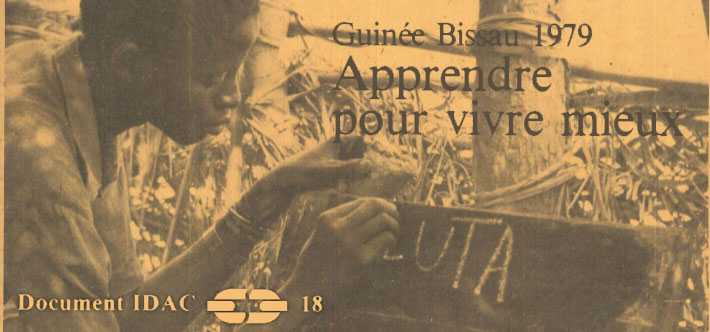
During the exile , Freire and colleague of IDAC developed an important adult education project in Guinea Bissau
The requirement to change country and adapt repeatedly to new languages and cultures, imposed to the family of Paulo Freire not only abandoning their land and its people, but also the face of prejudice and discrimination situations. In talks with Frei Beto, Freire said that exile was deeply teaching. Being forced to live in other countries, the educator had a chance to understand himself and understand Brazil better. He reports:
“It was just getting away from it, worried about it, I wondered about it. And when he asked me about it, I wondered what they did with other Brazilians, thousands of Brazilians of the young generation and my generation. Was taking away what I did, to take the interim context, I could better understand what I did and I could better prepare myself to continue doing something out of my context and also I prepare for a possible return to Brazil. ”
Excerpt from a conversation with Frei Betto, taken from the book “The school called life” (pp 56-8.) – In Paulo Freire: A Biobibliography.
In the video below, his youngest son, Lutgardes Freire tells us about the experience of exile in a child’s perspective. It reports, for example, which was called “Lut – garbage” in the United States.
Relearning Brazil
“Sixteen years of absence require a learning and greater intimacy with Brazil today. I came to relearn Brazil. ”
(Paulo Freire, still at the airport upon his return to Brazil In Paulo Freire:. Biobibliography one.)
The return of Paulo Freire in Brazil was a historic moment for education in Brazil. After several attempts to get his passport in Brazilian consular representations in different countries, Paulo Freire finally gets the document thanks to a writ of mandamus.
In June 1980, at age 57, Paulo Freire landed at Viracopos airport in Campinas, definitely returning to the country he had left in 64, under the command of the military. His desire was to resume the functions at the University of Pernambuco, but the restrictions still imposed prevented. He settled in São Paulo. He accepted an invitation to teach at the Faculty of Education at Unicamp, in Campinas and soon after joined the Postgraduate Studies Program in Education (supervision and curriculum) at PUC / SP.
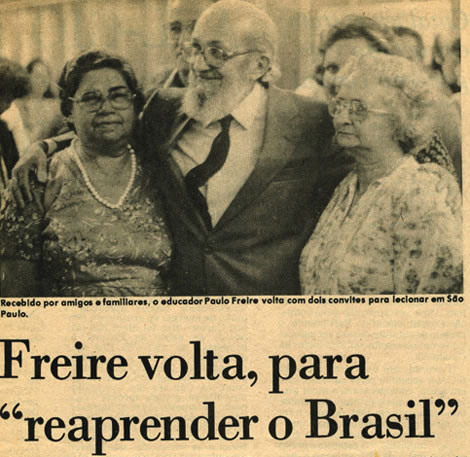
Newspaper story about the return of Freire .
Paulo Freire participated in the founding of the Vereda – Center for Studies in Education, also in São Paulo, whose goal was to develop research, provide advice and act in teacher education dedicated to the practice of popular education. He involves thus the movements of teachers, popular education movements and the struggle of the working class with young educators, valuing them and developing learning work together. He lived moments of great knowledge and productivity throughout her relearning of Brazil.
Veiled losses, forced departures
Impossible to analyze Freire’s exile in comparison to illegal immigration in the Mediterranean. The teacher returned to Brazil in 1979 and was warmly greeted by family and friends, with the task of “re-learn” their country, as reported at the time. But it is not the same way 1.800 people may have their destinations narrated. The brutality of authoritarian regimes in their countries, in addition to low travel conditions of this population led them to a path of no return.
For the 218.000 immigrants who have succeeded in their crossings by the Mediterranean Sea, it is not difficult to predict the course of their lives. With strong xenophobic wave plaguing Europe since the 2008 crisis, immigrants, legal and illegal, are considered strange beings to the territory, enemies, people who arrive in order to occupy jobs that could be filled by Europeans. Renegade and illegal, the 218.000 people who try their luck in foreign countries leave their past, their history, their training, their knowledge and often live as paupers in other lands.
Although course, different histories and conditions, a link joins Freire not only to 218.000 illegal immigrants who crossed the Mediterranean in 2014, but all who are expelled from their countries at risk of life: the political struggle.
Just as the exile of the popular educator was prejudicial to combating illiteracy in Brazil, this wound that is felt to date, the diaspora population characteristic of authoritarian countries has also sad consequences for their societies. The reading of the World and the wealth of knowledge that these immigrants bring with them to leave, are losses that set in large “gaps” in the political struggles in favor of the “ragged of the world.”
It is not possible to measure or to count how much each country loses in relation to social and educational development, if we consider the political struggles disrupted when leaders, like Paulo Freire, find themselves forced to migrate to survive.