 English
“The critical position is the one that taking epistemological distance of the concreteness where I am, with what I know best, I find that the only way to get out of it is the in the concretion of the dream, which, then, turns into new concreteness. “
(Paulo Freire, Pedagogy of Indignation)
Author: Afonso Celso Scocuglia
Publisher: DP et Alii / FAPERJ (RJ, 2013, 208p.)
To organize this book we sat articles, chapters and parts of books published in Brazil and abroad, plus two unpublished texts. All of them were reviewed, amended and/or supplemented by the reading of the Freire’s work and our own writings .
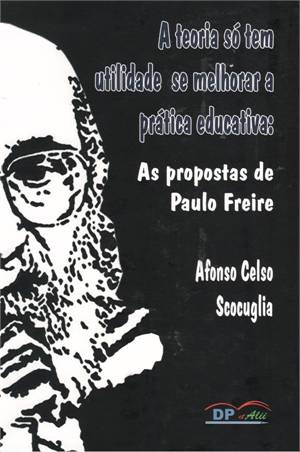 In the Introduction, the striking aspects of educator’s life and work, with some changes in language, come from the article published in the newspaper of Paraíba ( João Pessoa , 1997) and reproduced in other periodicals, shortly after the educator death. Part I of the book contains the historical context and procedures of the military coup that banned the execution of the “Paulo Freire method”. They were part of my doctoral thesis ( UFPe , 1997). The article Origins and prospects of Paulo Freire’s political-pedagogical thoughts, placed below ( Part II ) , was published in Education and Research newspaper , Faculty of Education, University of São Paulo ( USP , 1999) . Translated and supplemented , this article was also published as Origines et évolutions de la pensée politico-pédagogique of Paulo Freire (Révue RELIANCE, Lyon/France, 2007) with Jean – Claude Regnier.
In Part III, there are reflections on the influence of Amilcar Cabral and in the work in Africa in Freire’s praxis (1970) that are the result of a conference where I have spoken at the opening of an International Meeting of the Paulo Freire Forum, held in Praia, capital of Cabo Verde (Africa, 2010). In the sequence of the book, the concepts of “awareness in the postmodern transition” present in Freire’s work (Part IV ) composed the article published in the newspaper Education, Society & Culture, University of Porto ( Portugal , 2005). The learning, the knowledge and the construction of a curriculum in Freire’s perspective are the article ( Part V ) published in the Newspaper of Education Lusophone University of Humanities and Technologies (Lisbon, Portugal , 2005). The focus of the critical-reflective political educator training was written based on the book The story of Paulo Freire’s ideas and the current crisis of paradigms , of our own authorship (Joao Pessoa, 2006), and forming Part VI of the book. Two unpublished texts in terms of publication (Parts VII and VIII ), presented at conferences in Brazil (Unisinos , USP , Unicamp and UFPB) and abroad (University of Madeira and Université de Lyon) , make the following book: “Paulo Freire and the pedagogy of the research ” and ” Paulo Freire and the construction of popular public school.” Reflection on the ‘education of youth and adults people in the history of the present time”, in UNESCO’s vision which is convergent with Freire’s historical proposals (Part IX ), was published in Social movements and adult education in Ibero-America ( Liber Book, 2011 ). It demonstrates how present, relevance his legacy is, as well it has theoretical connections. In this same sense, Paulo Freire’s social pedagogy as a counterpoint of globalized pedagogy, it was firstly published in Social Pedagogy book (Publisher Expression and Art/USP, 2008) corresponds to Part X of the book .
In concluding remarks, the theoretical connections that strengthen the freirian legacy point , in my view , the main wealth and the real possibilities , present and future ones, of Paulo Freire’s proposals.